Services
Product Engineering for the AI Era
Use AI-era speed without losing clarity about outcomes, tradeoffs, and quality.
Start with our AI agent. Find your next step.
Delivery Snapshot
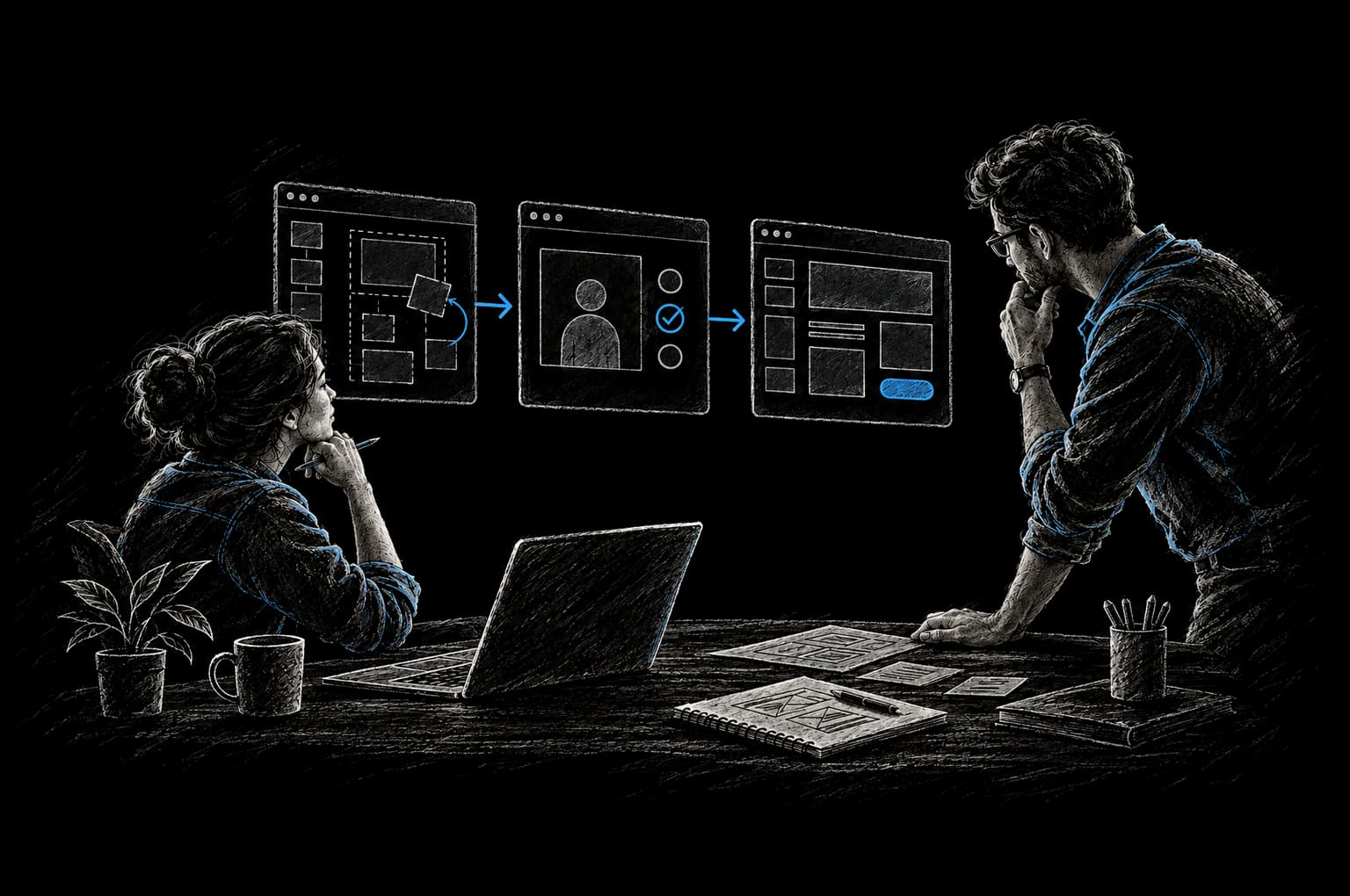
Unified product and engineering
- Define business intent before execution
- Keep product and engineering decisions together
- Measure whether the shipped work changed the outcome
The way software gets built is changing faster than most organizations realize. The constraint that used to be execution speed (how quickly engineers can code) has shifted. Today, the real bottleneck is clarity of intent. And that shift is dissolving the boundary between product and engineering.
For decades, the model was sequential: product managers defined requirements, engineers built them, and the handoff was a spec. That worked when building took months. It breaks completely when building takes days.
AI-assisted development has compressed timelines so dramatically that the old separation no longer functions. By the time a detailed spec is written, an engineer with AI tools can already have a working prototype. The question isn't "can we build this?" anymore. It's "are we building the right thing, and are we building it in a way that lasts?"
The Shift in Engineering Paradigm
The DORA Report 2025 (opens in a new tab) found 80% of developers report productivity gains with AI tools and 59% report improved code quality. That's real. Adoption is nearly universal too: DX found that 92.6% of developers use AI tools at least monthly. But McKinsey's State of AI 2025 (opens in a new tab) found that only 21% of organizations using gen AI have actually redesigned their workflows around it.
The gap exists because speed without clarity is dangerous.
METR's 2025 trial found experienced developers were 19% slower with AI tools on mature codebases they knew well; the gains depend on clear intent and disciplined review. In our view, that is because AI amplifies judgment. When you give an engineer with unclear intent access to AI tools, they move faster in the wrong direction. When you give them crystal-clear intent, they move faster in the right direction.
This means the engineering paradigm has fundamentally changed:
The bottleneck moved from execution to intent. Engineers can now deliver working code in hours that used to take weeks. But that code only serves the business if the intent behind it is precise and shared before work starts.
Engineers need product instincts. In the AI era, engineering isn't about implementing specs. It's about understanding user problems, business outcomes, and tradeoff decisions. Engineers who can reason about these questions are invaluable. Engineers who can only execute tickets are interchangeable.
Product leaders need engineering fluency. You can't lead product in the AI era without understanding what's feasible, what's reversible, what creates technical debt, and what tradeoffs matter. Guessing doesn't work when execution is this fast.
The firms that will compete effectively aren't those with the fastest engineers. They're those with unified teams where product thinking and engineering execution are one process, not two sequential ones.
Why the Traditional Product/Engineering Split Fails Now
The classic model assumed that product and engineering were separate concerns. Product figures out what to build. Engineering figures out how to build it. Then they pass work back and forth.
This model required long lead times to justify the overhead. You'd spend six weeks writing specs so that engineers had clear enough direction to execute for three months. That ratio worked when the problem was expensive execution.
But when execution became cheap, the ratio inverted. Now the cost isn't the build. It's the delay between learning something and acting on it. A two-week spec delay before a two-day build means you're operating on two-week-old information.
Worse, specs become obsolete instantly. Once execution starts, you learn things about the problem that invalidate the original spec. The engineer either has to stop and wait for a new spec, or they have to make product decisions on their own. Neither option is good.
The split also creates misaligned incentives. Engineers optimize for on-time delivery of specs. Product optimizes for hitting a roadmap. Neither optimizes for business outcomes. Both sides end up protecting their respective turfs instead of collaborating on the actual problem.
In the AI era, this split is a liability. You need to know whether you're building the right thing as you're building it, not months later when it ships.
What Unified Product Engineering Looks Like
Product engineering is the practice of dissolving the boundary between product strategy and technical execution. It doesn't mean engineers write specs or product managers write code. It means they share a single definition of what success looks like and they collaborate continuously to get there.
In a unified model:
Engineers own outcomes, not just tickets. An engineer doesn't close a ticket and move on. They understand the hypothesis being tested, the metrics that matter, and whether the work actually moved the needle. They have skin in the game.
Product leaders drive intent, not just timelines. A product leader's job is to make sure the intent is crystal clear before work starts, then get out of the way. Document the reasoning. Explain the tradeoffs. Answer questions. But don't pretend to know the implementation details better than the engineer does.
Decisions are documented with their reasoning. Not just what was decided, but why. This is critical in AI-era development because context becomes your speed multiplier. When an engineer understands not just the requirement but the business reasoning behind it, they can use AI tools to explore more of the design space faster.
Quality gates exist before shipping, not after. In a unified model, QA and engineering collaborate during build, not as a downstream checkpoint. You catch issues while they're easy to fix, not when they're expensive.
Metrics are defined before building, measured after shipping. You don't finish and then wonder what to measure. You know what success looks like before code touches a repo.
This is fundamentally different from the old model. It's faster not because of AI, but because the overhead of the product/engineering split is eliminated. AI is the accelerant, not the change itself.
The Role of AI in Modern Engineering
There's a lot of hype about AI replacing engineers. That's missing the point entirely.
AI tools are amplifiers of judgment. They're exceptionally good at code generation, at exploring design patterns, at remembering libraries and syntax, at writing tests, at catching certain categories of bugs. They're terrible at deciding what to build, why it matters, or whether it's the right tradeoff.
The engineers who will thrive in the AI era aren't the ones with the best syntax memory. They're the ones with the clearest judgment about what matters. They're the ones who can take a fuzzy user problem and translate it into precise technical requirements. They're the ones who understand business constraints and can navigate tradeoffs.
AI doesn't replace that judgment. It accelerates execution once the judgment is clear. The faster you can execute, the more critical clear judgment becomes.
How InTech Embodies This Model
InTech Ideas was built from scratch on the principle that product engineering is the future. We created two frameworks to operationalize it.
Pro-Neering is our philosophy: engineers own outcomes, and every engineer on your team is expected to think like a product person. That doesn't mean they write specs. It means they ask "why?" before they code. They understand the business problem. They propose better solutions if they see them. They measure results.
CRAFT (Context, Rationale, Automate, Fortify, Telemetry) is InTech's operating system, the governance underneath strategy, product engineering and managed operations. Pro-Neering is the philosophy behind it. In product engineering, CRAFT is how we execute at speed while keeping technical debt visible and managed:
- Context: Shared truth before build. Not a 50-page spec. A focused document that explains the problem, the user, the business outcome, and the constraints.
- Rationale: Decisions documented with reasoning. This is your speed multiplier because it lets AI tools and your team explore the design space faster.
- Automate: AI-assisted execution with proportional human oversight. We use AI to move fast, but we don't autopilot. Every critical path gets review.
- Fortify: Quality gates before shipping. Testing, security, performance: all built in, not bolted on.
- Telemetry: Outcome measurement after shipping. We know whether it worked.
We deliver this through pods. An Express Pod puts one measurable improvement into production in weeks, with the timeline agreed in the Intent Contract before build starts. The Build Pod is ongoing delivery capacity with a Product Delivery Lead, staffed to the shape of the work and managed against outcomes. Commercial terms are agreed per engagement. The Build Pod can be configured for multiple workstreams when larger teams run in parallel. Every pod includes a Product Delivery Lead, engineers who own execution, and support for DevOps, QA, and design. A Product Delivery Lead is accountable for the outcome, managing intent, milestones, and the rhythm of delivery across the engagement. Once the product is live, InTech Operate can run and improve it as a managed service.
The result is teams that move fast without burning out. Teams that ship while keeping the codebase maintainable. Teams that know whether their work actually moved the business.
Business Outcomes This Creates
When product and engineering are unified:
Time to value drops dramatically. You're not waiting for specs. You're not debating between separate product and engineering roadmaps. Work starts with clear intent and moves continuously to shipping.
Technical debt stays manageable. When engineers care about outcomes, not just velocity, they make different tradeoffs. They push back on shortcuts that would haunt them later. They own the code they ship.
Teams stay stable. Constant context switching and misalignment burn people out. Unified teams with clear outcomes have lower churn and higher output.
Learning loops are fast. You ship, measure, learn and adapt, all in weeks rather than quarters. That agility is a competitive advantage.
Questions About Product Engineering in the AI Era
Doesn't this require senior engineers? Can we scale it to a larger team?
Senior judgment matters, yes. But judgment compounds when it's shared. A great PDL who communicates intent clearly amplifies the judgment of the whole team. We've scaled this to 8+ person teams. The key is discipline around context and clear decision-making, not the individual brilliance of one person.
How do you avoid scope creep without a product spec?
The context document is your boundary. It explicitly includes constraints and tradeoffs. When something falls outside that scope, it's a visible decision to expand, not a slow drift. And PDLs are ruthless about saying no to things that don't serve the core intent.
What if the engineer and the product person disagree on direction?
That's exactly when unified product engineering works best. They're collaborating from day one, not hand-passing specs. Disagreements surface early, when they're cheap to resolve. Usually the disagreement surfaces a question nobody had answered yet: the PDL clarifies, the engineer adjusts, you move on.
Does AI actually make this faster, or is it hype?
Yes, when intent is clear. AI is worse than useless when people are guessing. But when you know what you're building and why, AI tools genuinely compress execution time. METR's 2025 trial found experienced developers were 19% slower with AI tools on mature codebases they knew well, which is why the gains depend on clear intent and disciplined review. AI amplifies both clarity and confusion.
How do you measure whether it's actually working?
Before you build: metrics defined, hypotheses stated. After shipping: did those metrics move? If yes, you're learning fast and compounding advantage. If no, you learned something for the next cycle. Either way, you have data, not opinions.
What's the difference between this and just having a smart product manager?
A smart product manager is necessary but not sufficient. The difference is that in unified product engineering, every engineer is expected to think like a product person. You're not bottlenecked on one person's availability or judgment. The whole team is aligned and empowered.
From Friction to Proof
Bring us the part that’s getting in the way.
Tell our AI agent what you want to improve. We’ll help you find a useful first step.
Start with our AI agent. Find your next step.