Services
AI Integration Services
Connect CRM, ERP, finance, operations, and workflow systems so AI can act with governance.
Start with our AI agent. Find your next step.
Delivery Snapshot
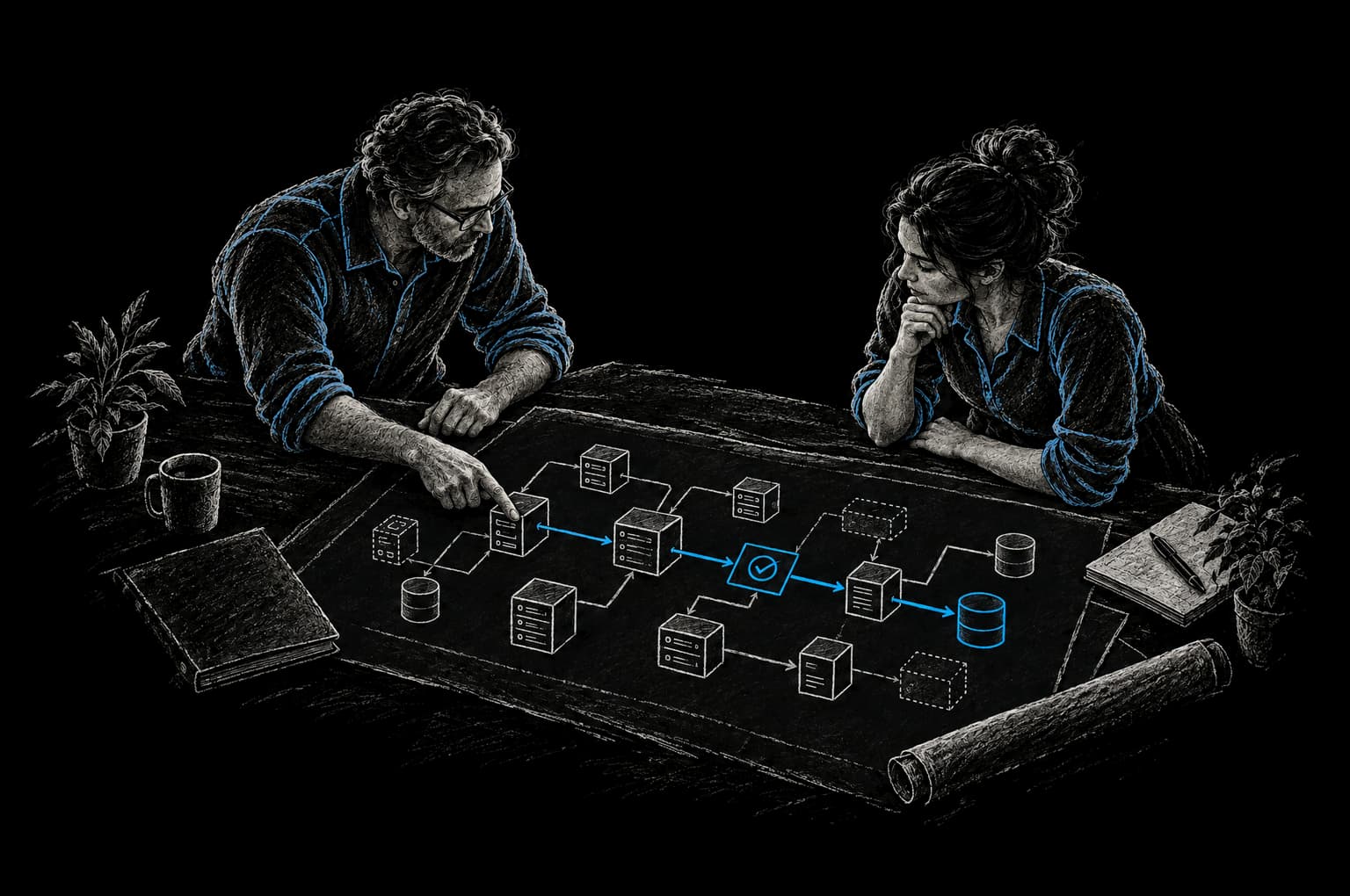
Connected systems for AI operations
- Map authoritative systems and data ownership
- Add approval gates and audit trails for AI actions
- Instrument telemetry across every connected workflow
Integration means something different now. Five years ago it meant connecting two systems with an API. Today, in the AI era, AI integration services connect your business systems so artificial intelligence can operate across them. Not just route data. Read from systems, write to them, and act inside them with governance.
Most companies are not there yet. Sales data lives in the CRM, which does not talk to accounting, which does not talk to operations, which does not talk to the warehouse. Each system holds a different version of the truth. Manual data re-entry is the norm. The AI features that could actually move the business never get built because the underlying data is not connected, not clean, and not governed.
This is the integration problem InTech Ideas solves. We connect your systems so your teams have one source of truth, your workflows run with the right level of automation, and your AI Operating System actually has something to operate on.
What are AI integration services?
AI integration services connect existing business systems, including CRM, ERP, finance, and operations, so artificial intelligence can read from them, write to them, and act across them with governance.
A complete AI integration covers four layers:
- Data connectivity: APIs, event streams, and ETL pipelines that keep source systems in sync
- Workflow orchestration: routing actions across tools with state, ownership, and exception handling
- Supervised agent execution: bounded tool access, approval gates on consequential writes, and audit trails on everything
- Telemetry: visibility into what every agent and every integration actually did, so the system can be reviewed, improved, and trusted
Most providers stop at the first two layers. We do not. The integration that matters in the AI era is the one that lets supervised agents run real workflows without losing the audit trail, the approval gates, or the human in the loop.
Why AI integration services matter now
AI integration services exist because the operating environment got more complicated, not less. The average company runs between 106 and 275 SaaS applications (opens in a new tab). Most are not talking to each other. Salesforce data suggests only 29% of the software tools a business uses are actually integrated (opens in a new tab).
Pre-AI-era integration was about getting data to flow for reporting. AI-era integration is different. The data is flowing for autonomous action. An agent that drafts an email needs to read from the CRM, the support history, and the order system before it writes a word. An agent that triages inbound work needs read access to a queue, write access to an assignment system, and an approval gate before anything ships. The integration is not optional. It is the difference between an AI feature that demos well and one that runs the business.
The compound cost of fragmentation shows up everywhere. Your customer success team looks up a customer in three systems before they can answer one question. Data quality drifts every time information is re-entered. AI capabilities that depend on clean, connected data never get built because the data is not there.
McKinsey found data-driven organizations are 23 times more likely to acquire customers, six times as likely to retain them, and 19 times as likely to be profitable. That is a business outcome, not a technology outcome.
How InTech approaches AI integration
We do not start with connectors. We start with the data layer.
Clean, connected, authoritative data is the prerequisite for everything else. For workflows. For supervised agents. For the visibility that lets leadership trust the system. Once your data layer is sound, the rest follows.
Our approach has six elements.
Data layer first. We map your authoritative sources. What is the single source of truth for customers, orders, inventory, financials. If systems disagree, we establish hierarchy and reconciliation rules before engineering begins.
API-first where possible. If your systems have good APIs, we build connectors that sync automatically. This is the cleanest path because you are using the systems as designed.
Event-driven for real-time flows. When data needs to move immediately, like an order triggering fulfillment and invoicing, we build event-driven architectures so systems react to state changes rather than polling.
ETL and data pipelines where batch sync is appropriate. Not everything moves in real time. Some data is best synced nightly or on a schedule. We design pipelines that are transparent, idempotent, and easy to debug.
Custom middleware when off-the-shelf connectors do not fit. Integration tools cover the common cases. Your workflow is probably not common. We build custom logic that bridges the specific gaps in your stack.
Supervised agent integration. When an agent acts on real systems, integration includes the policy layer. Bounded tool access. Approval gates on consequential writes. A Telemetry Ledger that records every action and every override. Without it, the integration is brittle and the agent is dangerous.
Common AI integration patterns we build
CRM to accounting. Sales closes a deal. That data flows to accounting to create an invoice and update revenue records. We eliminate manual entry and give finance one authoritative source for contracts and ARR.
Customer communication to operations. Support tickets, emails, and call logs live in a communication platform. Fulfillment and field service need context about what the customer actually needs. We connect support systems to operational databases so every team member has the full picture.
Field operations to billing. A technician completes a job on site. That event triggers an invoice, updates inventory if parts were used, and logs work history. We build the connectors that turn task completion into billing and visibility automatically.
Inventory to ordering to fulfillment. Inventory needs to talk to ordering, so you do not oversell, and to fulfillment, so pickers know what to ship. We build the single source of truth that coordinates all three.
AI data pipelines. You want to ship a recommendation engine, a predictive analytics dashboard, or a workflow that routes customers intelligently. The model needs clean data from multiple sources. We build the pipelines that extract, transform, and load it so the model has what it needs.
AI agent to operations data. An agent triages inbound work, drafts responses, and schedules follow-ups. It needs read access to the CRM, write access to a queue, and approval-gated write access to email and calendar. We build the integration plus the policy layer that lets the agent act safely. This pattern is the heart of an AI Operating System.
AI integration with governance: the CRAFT methodology
We use the same discipline for AI integration work that we use for product development. CRAFT (Context, Rationale, Automate, Fortify, Telemetry) is InTech's operating system, the governance underneath strategy, product engineering and managed operations. Pro-Neering is the philosophy behind it.
Before we design architecture or write a line of code, we define what AI integration success looks like. Not the technical spec. The outcome. What workflows change. What data is now authoritative. How the team will know it is working. This is captured in an Intent Contract. An Intent Contract is a short, signed-off statement of the outcome, scope, success metrics, constraints, human authority boundaries and acceptance criteria. It is not a legal agreement; commercial terms live in the engagement agreement. It becomes the north star for the project. Without it, integration projects drift, scope creeps, and nobody can answer whether the work was successful.
Disciplined architecture. We design for the data you have today and the scale you will reach. We pick technologies that are boring, proven, and maintainable. We document the data model so the next engineer knows what is happening without three weeks of archaeology.
Telemetry from day one. Integration projects succeed when the integration stays working. We instrument the data flows and the supervised agent actions so we can see when records fail to sync, when data quality degrades, when a connector goes stale, when an agent escalates an unusual decision. The Telemetry Ledger is part of the deliverable, not an afterthought.
This is what we mean when we say AI governance services. Not an external compliance audit. The governance is built into how the integration runs every day.
Generative AI integration: agents, RAG, and supervised execution
Generative AI integration services are different from classical AI integration. The AI is not a deterministic model scoring rows. It is an LLM that reasons, drafts, and sometimes hallucinates. Integrating that kind of system into a real business requires three things classical integration does not.
Retrieval-augmented context. The model needs to ground its answers in your data, not its training set. We build retrieval pipelines, often called RAG, that pull the right context from your systems at runtime. CRM records for a customer-facing agent. Knowledge base articles for a support agent. Operational state for a triage agent. The retrieval layer is a piece of the integration, not a separate concern.
Supervised agent orchestration. Generative AI in production is not one model call. It is a sequence: receive input, retrieve context, plan action, propose output, route to a human if confidence is low or stakes are high, execute. We build the orchestration that runs this sequence inside your workflow systems, with bounded tool access at every step.
Approval gates and audit trails. Because generative output is non-deterministic, the integration has to record what the model proposed, what the human approved, and what eventually shipped. The Telemetry Ledger captures all three. This is what makes the system trustworthy enough to put in front of customers, in front of revenue, or in front of decisions that matter.
This is what AI-Native means at the integration layer. Not bolted on. Not generative AI as a feature flag. Generative AI as part of how the workflow actually runs, with the governance built in.
What InTech delivers vs. AI integration platforms (Zapier, n8n, Make)
If you are evaluating AI integration services, you have probably also looked at platforms like Zapier, n8n, and Make. They are good tools. We use them where they fit. But they do not solve every problem and the difference matters.
Platforms like Zapier and Make excel at the long tail of common-shape workflows. Trigger in tool A, action in tool B, occasionally a branching condition. If your integration is mostly that pattern, configure it on a platform and ship in a day. We will tell you that.
Platforms struggle when the workflow has policy requirements, custom logic, supervised agents, or compliance requirements that go beyond a built-in approval step. They struggle when the integration needs to maintain state across long-running processes. They struggle when you need an audit trail you can put in front of a customer or a regulator. They struggle when the AI step needs grounding context from three systems and a vector store.
InTech is what you call when the platform stops working. We build the custom integration on your infrastructure, so you keep ownership of the logic, data, and audit trail. We build the policy layer the platforms do not have. We build the agent orchestration that connects to whatever the platform did configure. The two coexist. We are not a platform replacement. We are the answer for the workflows the platforms cannot reach.
Delivery models for AI integration services: Express Pod and Build Pod
We deliver AI integration work through two pod configurations. Both run on CRAFT methodology and both assign you a Product Delivery Lead, but the engagement shape changes based on what you need. A Product Delivery Lead is accountable for the outcome, managing intent, milestones, and the rhythm of delivery across the engagement.
An Express Pod puts one measurable improvement into production in weeks, with the timeline agreed in the Intent Contract before build starts. It is the right fit for a focused integration project with a defined scope: one or two systems connected, with clear success metrics. You get a working integration, full documentation, and runbooks your team can operate from.
The Build Pod is ongoing delivery capacity with a Product Delivery Lead, staffed to the shape of the work and managed against outcomes. Commercial terms are agreed per engagement. It is the right fit if you are expanding your integration surface over time, or building a connected product that grows with the business, working alongside your team.
When AI integration is part of a larger product engagement, the Build Pod is configured for multiple workstreams. You are building a new product with AI capabilities and integration is a prerequisite. More engineers, parallel delivery, and Product Delivery Leads accountable across the streams.
Every configuration runs on your infrastructure: your repositories, your cloud accounts, your databases, your edge. You own the code, repositories and infrastructure we build for you. What you own at the end of an engagement is set out in your MSA and explained in What You Own and What We Keep.
AI integration outcomes you should expect
Done right, AI integration produces measurable change in how the business runs. Here is what good looks like.
A first integration in production. Through an Express Pod, the first integration reaches production in weeks, on a timeline agreed in the Intent Contract. Multi-system pipelines with transformation logic and a supervised agent on top are delivered in stages.
Less manual data re-entry. On the workflows that get integrated, re-keying drops away. What remains is the judgment-shaped work that should stay with people.
Data quality improvement. Measurable as a drop in cross-system inconsistencies. The Telemetry Ledger surfaces this directly because every reconciliation run is logged.
Faster AI features after integration. Once the data layer is sound, generative AI features that depend on connected context become much faster to ship. The data work is usually what was holding them up, not the model work.
A complete audit trail. Supervised agent actions are logged with input, output, approver, and override history, so the record is ready when compliance asks for it.
We agree with you on the baseline, the targets, and how they will be verified before work starts, and report the result against that baseline.
Frequently asked questions
What is an AI integration service?
An AI integration service connects existing business systems so artificial intelligence can read from them, write to them, and act across them under human governance. A complete integration covers four layers: data connectivity, workflow orchestration, supervised agent execution, and telemetry.
How do companies integrate AI into their existing systems?
In four stages. Get the data layer right by mapping authoritative sources. Connect them through APIs, events, or ETL depending on freshness. Add a governance layer defining what an agent can read, write, and approve without human review. Instrument telemetry so leadership sees what the system did and why.
How long does a typical AI integration project take?
It depends on the number of systems and the shape of the workflow. An Express Pod puts one measurable improvement into production in weeks, with the timeline agreed in the Intent Contract before build starts. A larger integration estate runs as a Build Pod, delivered in stages, with the timeline for each stage agreed before work on it starts.
Do we need a data warehouse to integrate AI?
Not always. For a few SaaS tools talking to each other, a warehouse adds cost without gain. For generative AI features that need retrieval-augmented context across many sources, or analytics that span systems, a warehouse or data lake earns its keep. We recommend based on what the workflow needs.
What if one of our systems does not have an API?
More common than it should be. We can often work through exports, database access, screen automation, document capture, or custom middleware. If replacement really is the better path, we'll tell you plainly. The integration plan adapts to what your stack allows.
What is the difference between AI integration and middleware?
AI integration is the outcome: your systems working together so AI can act across them with governance. Middleware is one of the tactics that gets you there. Middleware alone does not deliver AI integration. You also need the data layer, the workflow orchestration, the policy layer, and the telemetry.
What happens after the AI integration goes live?
You own the code, repositories and infrastructure we build for you. What you own at the end of an engagement is set out in your MSA and explained in What You Own and What We Keep. We document architecture, data model, connector logic, agent policies, and telemetry setup. From there, your team can run the system, a Build Pod can keep developing it, or InTech Operate can run and improve it as a managed service, with the same evaluations and telemetry.
How do we know if the AI integration is actually working?
Telemetry. We instrument every data flow and every supervised agent action. You see sync failures, data quality drift, agent error rates, and approval-gate latency in real time. After launch, we review the results against the baseline and targets in the Intent Contract to confirm the outcomes are landing.
Related: methodology and operating-system context
AI integration services do not exist in isolation. They are the connective layer of the broader system. If you want the rest of the picture:
- What is the CRAFT methodology? The five-discipline operating model that governs every integration we ship. Context, Rationale, Automate, Fortify, Telemetry.
- AI Operating Systems for Business How integrated data, workflows, and supervised agents combine into a unified operating layer that leadership can actually run on.
- AI Automation Consultant Implementation partner services for teams that need the automation shipped, not just recommended.
- Too many disconnected systems: how to fix fragmented business operations The problem space we keep meeting. Why fragmentation compounds, what the fix looks like, what it costs to wait.
- Connecting SaaS tools the right way Practical patterns for the most common connection problem, with notes on when a custom integration earns its keep over a configured platform.
If you have a system that is holding your team back, tell us what is broken. We reply within one business day, and we will tell you whether AI integration services are the right answer. Let's talk.
From Friction to Proof
Bring us the part that’s getting in the way.
Tell our AI agent what you want to improve. We’ll help you find a useful first step.
Start with our AI agent. Find your next step.