AI Operating Systems
AI Transformation for Mid-Market Companies
Sequence AI work around the workflows that matter most so transformation does not stall the business.
Start with our AI agent. Find your next step.
Operating System Lens
Pragmatic AI transformation
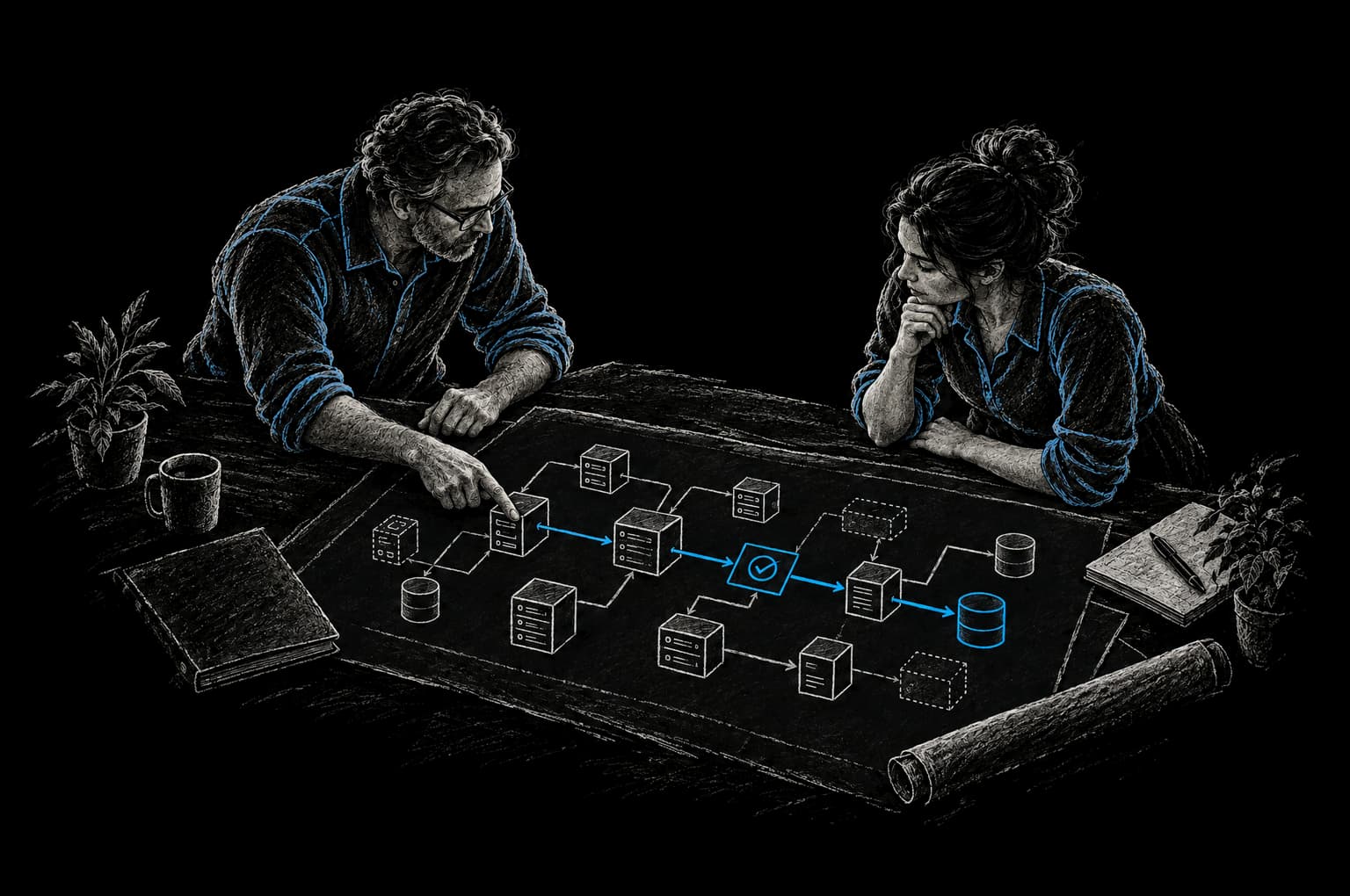
- Pick a high-value operating wedge
- Connect the data foundation first
- Expand after results prove the model
You know AI matters. Your board mentions it in every meeting. Your competitors are talking about it. Your team thinks you need a strategy. But when you actually look at what transformation means, the path isn't clear.
If you run a mid-market company (roughly $10M to $250M in revenue), you're not facing the same AI challenge as a Fortune 500 enterprise or a 10-person startup. Large enterprises have dedicated CDOs and transformation budgets. Startups were born in the AI era. You're somewhere different: you've built a real business with complex operations, established workflows, and a team that can't afford much downtime while you rebuild.
This is the mid-market AI challenge. And it has a solution that doesn't require betting your company on a three-year transformation program.
Why Mid-Market AI Is Different
The gap between AI adoption and actual business impact is real. McKinsey's 2025 State of AI report found (opens in a new tab) that 78% of organizations now use AI in at least one function. But 80% of them report no clear bottom-line effect yet. In our experience, the problem is rarely access to AI. More often it's implementing AI in a way that actually changes how your business runs.
For mid-market companies, that gap is even wider.
Here's why: Your operations didn't grow because you optimized processes. They grew because you added headcount. You hired someone to manage the QuickBooks data. You hired someone to track the CRM. You hired someone to coordinate between the two because they still don't talk to each other. Over time, you've accumulated a technology stack that looks like this: legacy systems, modern SaaS tools, spreadsheets as a workaround, and institutional knowledge locked in people's heads.
You also have another constraint that enterprises and startups don't: Your business can't pause. You can't shut down for six months while you rebuild from scratch. You have cash flow to manage, customers to serve, payroll to meet.
Large enterprises solve this with enterprise transformation programs and dedicated budgets. Startups solve this by design: they chose their tools from day one with AI in mind. You're working with what you've built, and you need to improve it without breaking it.
The stakes are high. Manual re-entry and reconciliation across disconnected systems is a recurring cost most mid-market companies have never measured. The assessment measures it.
What AI Transformation Actually Means for Mid-Market
AI transformation doesn't mean replacing all your systems. It doesn't mean a massive change management program. It doesn't mean you need a Chief Data Officer and a team of 50 engineers.
For mid-market companies, AI transformation is pragmatic and sequenced. It looks like this:
Identify the workflows that cost you the most. Not every process benefits from AI. Start with the ones that consume the most time, cause the most errors, or cost you money every month. For a professional services firm, that might be proposal generation and delivery tracking. For a field service company, it's scheduling and technician communication. For a staffing agency, it's candidate matching and onboarding.
Connect the data those workflows depend on. Your systems hold the data. Your processes just can't see all of it at once. A staffing agency knows candidate history in the ATS, but onboarding status, client feedback, and payroll handoffs often live somewhere else. A professional services firm has projects in one system and invoicing in another. Connecting these sources of truth is the hardest part of AI transformation, not because it's technically complex, but because it means looking at how your business actually works, not how you think it works.
Apply AI where it reduces manual work and improves decisions. Once the data is connected, AI can do the pattern recognition and decision support that your team currently does by hand. That might look like automatically generating compliance summaries, routing leads to the right team member, predicting churn before it happens, or catching errors before they cost you money.
Measure outcomes, then improve the next workflow. This is the part most transformation programs skip. How much time did we actually save? What's the business impact? What's the next bottleneck? This feedback loop is what separates a transformation that sticks from one that looks good for 90 days then fades.
This approach is reversible. If something doesn't work, you pivot. You're not betting the company. You're validating the approach in the area where it matters most, then expanding from there.
Where to Start: The Pragmatic Sequenced Approach
The biggest mistake mid-market companies make is trying to boil the ocean. They commission a "digital transformation strategy." They plan an 18-month program. They budget six figures. Then the first project slips, the second one underwhelms, and they shelve the whole thing.
Start smaller. Validate faster.
Step one is your first improvement. Pick your most painful workflow. Connect the data it needs. Apply AI to the part that wastes the most time or causes the most error. Put it into production in weeks, not quarters. Measure what changed against the baseline you agreed on at the start: time savings, error reduction, business outcome. If it works, you have momentum and proof. If it doesn't, you learned that quickly and cheaply.
Then you expand. Maybe you move to the next workflow in that same department. Maybe you extend the same approach to another part of the business. The point is that every step is grounded in measured outcomes, not in a pre-planned roadmap that assumes you knew the answer before you started.
This approach works because it aligns with how mid-market companies actually make decisions. You have to see the result before you commit the budget. And pragmatically, that's smarter than betting six figures on a prediction.
What This Looks Like Across Industries
Hypothetical scenarios to show the pattern; figures are illustrative, not client results.
Professional Services Firm. A services business with 40 people generates 100+ proposals per year, each one requiring research, custom pricing, and terms negotiation. Half the time goes to finding the right information in past proposals. With connected data and AI-assisted proposal generation, you reduce the time per proposal from four hours to one, validate pricing faster, and improve close rates because your proposals are data-backed. At 100 proposals a year, that recovers about 300 hours.
Field Service Company. Technicians are in the field. Dispatch happens in one system. Customer communication happens in another. Updates happen via phone calls and texts. By connecting scheduling, technician location, work orders, and customer notification, you can automatically route jobs to the nearest technician, predict delays before they happen, and keep customers informed. The result is faster completion times, fewer no-shows, and less time your dispatcher spends on the phone.
Staffing Agency. A new job order comes in. Recruiters search the ATS, review resumes, check availability, confirm compliance status, and send updates to the client by email. Connect candidate profiles, job orders, client history, onboarding status, and billing workflows. AI can surface better-fit candidates, flag missing compliance steps, generate client updates, and move placed candidates into onboarding without duplicate data entry. Recruiters spend more time on relationships and placements, not administrative work.
Medical Supply Company. Orders come in through a website, phone, and fax. Inventory lives in one system. Fulfillment and shipping happen in another. The customer sees different information depending on which system they look at. Connect these systems and apply AI to predict inventory needs based on incoming orders, automate order acknowledgment and tracking, and flag fulfillment bottlenecks before they delay a customer shipment. The result is faster fulfillment, fewer expedite calls, and inventory that actually aligns with demand.
In each case, the transformation isn't about new systems. It's about connecting the systems and data you already have, then using AI to handle the pattern recognition and decision support your team currently does manually.
Implementation: The Pod Model
InTech Ideas works with mid-market companies in pods. This model is built specifically for companies that can't afford a massive transformation budget and can't pause their operations while they improve them.
The Express Pod is your validation step. An Express Pod puts one measurable improvement into production in weeks, with the timeline agreed in the Intent Contract before build starts. It is sized to prove the approach before you commit to larger investment. You leave this phase knowing whether the approach works for your business.
The Build Pod is ongoing delivery capacity with a Product Delivery Lead, staffed to the shape of the work and managed against outcomes. Commercial terms are agreed per engagement. In practice, that means sustained execution, usually one or two workflows at a time. The difference from hiring full-time is that you're not adding headcount to your org permanently. You're building capability over time.
The Build Pod configured for multiple workstreams is when you're running several streams in parallel. Your team understands the approach. New workflows move faster. This is where you start seeing the compounding effect of integrated data and AI-assisted decision making across multiple areas of the business.
Once a workflow is live, InTech Operate can run and improve it in production as a managed service.
Every pod runs under CRAFT. CRAFT (Context, Rationale, Automate, Fortify, Telemetry) is InTech's operating system, the governance underneath strategy, product engineering and managed operations. Pro-Neering is the philosophy behind it. In practice, CRAFT means clear requirements, disciplined delivery, and measured outcomes at every step. No vague roadmaps. No feature creep. You know what you're building, why you're building it, and how you'll know it worked.
FAQ
How long does an AI transformation actually take?
Depends on scope. A single workflow usually reaches production in weeks, with the timeline agreed in the Intent Contract before build starts. A multi-workflow transformation across a company might take six to twelve months. The key is that you're validating outcomes one workflow at a time, not planning the whole program upfront and hoping it works.
Do we need to replace all our systems?
Not necessarily. Most mid-market companies have systems that work fine for their intended purpose. The gap is usually that they don't talk to each other. We start by connecting what you have, not by recommending a complete rebuild. Sometimes that reveals that a particular system is genuinely in the way, and then you have clear business justification to replace it. But that's a decision made on evidence, not on theory.
We've done technology projects that didn't deliver. Why would this be different?
That skepticism is earned. Most technology projects in mid-market companies don't deliver the promised ROI because they're built on assumptions rather than evidence. The pod model limits that risk. You validate the approach on one workflow, in production, before you commit real budget. If it works, you expand. If it doesn't, you know quickly and you can pivot.
Do we need a Chief Data Officer or someone dedicated to this?
No. You need someone on your team to be the business owner: the person who says "this is what success looks like." That might be a COO, a department head, or an operations manager. But you don't need to build a new department. The point is to improve how your existing team works, not to add organizational complexity.
What's the cost compared to hiring full-time engineers?
Cost depends on the number of systems and the complexity of the workflow. We scope it after an assessment and give you a clear price before work starts. Compared with hiring, you get focused execution on your specific workflow without the hiring friction, ramp-up time, or permanent headcount expansion, and you judge the pod on the outcome it delivers against your baseline.
How do we know this is working?
We measure it. Before we start, we define what success looks like for the workflow. How much time should it save? What errors should it eliminate? What's the business impact? Then we track it. As each workflow goes live, you see the results against that baseline. That's how you know.
From Friction to Proof
Bring us the part that’s getting in the way.
Tell our AI agent what you want to improve. We’ll help you find a useful first step.
Start with our AI agent. Find your next step.