Methodology
What Is Pro-Neering?
Pro-Neering is the philosophy behind CRAFT: product and engineering working as one discipline, with intent ahead of output.
Start with our AI agent. Find your next step.
Methodology
What this helps you do
- Understand the five core beliefs
- See how it changes discovery, build, and measurement
- Connect it to CRAFT and the Product Delivery Lead
Pro-Neering is the fusion of product management and engineering into a single unified discipline. It's built on a straightforward belief: product and engineering are not separate functions competing for priority. They are inseparable. When they operate as one, teams ship faster, with less waste, and with better outcomes.
This isn't new organizational advice. Pro-Neering was created by Skip Marshall, our CEO, years before AI engineering became a cultural conversation. What changed is context. When development accelerated through AI-assisted tools, Pro-Neering moved from "nice to have" to essential. The faster your tools, the more critical your intent. Speed without clarity produces faster waste.
Why This Matters Now
Most software teams operate with a fundamental split. Product defines what to build. Engineering figures out how. This division made sense when development moved slowly enough that clarification happened through iteration. In a six-month delivery cycle, you could discover misalignment early and course-correct.
Today, AI-assisted development (opens in a new tab) can turn a poorly understood requirement into working code in hours. The problem isn't shipping slower. It's shipping the wrong thing faster, then discovering the misalignment after the cost is sunk. This is what we call context collapse: teams move so fast that shared understanding breaks down, and the clearer the code, the more obvious the gap between intent and outcome.
Product teams feel this acutely. A product leader defines requirements that seem clear on a whiteboard, hands them to engineering, and six weeks later receives something functional but subtly wrong. The engineering team executed perfectly. They just didn't know what the product leader actually needed. By then, momentum, pride, and schedule pressure make it easier to ship than to rebuild.
Engineering teams feel it too. They build features in isolation, without understanding the broader product strategy or customer context. They optimize for technical elegance instead of measurable business outcomes. Halfway through a sprint, product changes direction, invalidating weeks of work. This happens not because product leaders are indecisive, but because engineering was never part of the decision. They were implementing, not partnering.
Pro-Neering solves this. It eliminates that gap by design.
The Core Beliefs
Pro-Neering rests on five core beliefs that reframe how product and engineering work together.
First: Intent matters more than output. A perfectly executed wrong solution is still wrong. Before any line of code is written, the team must have clarity on what success actually means. Not "we built the feature." Success means measurable movement on a business metric, customer behavior change, or operational efficiency. Intent starts as a question: what are we trying to change, and how will we know it changed?
Second: Engineers own outcomes, not just implementation. When an engineer is handed a spec and told to build it, they're positioned as a tool. When an engineer understands the problem, the constraints, the customer context, and the business outcome, they become a partner. They spot technical impossibilities before work begins. They suggest simpler paths. They catch misalignments because they understand what they're optimizing for. This doesn't mean engineers make product decisions. It means they have visibility into the reason behind every decision.
Third: Product leaders need technical grounding. You don't need every product person to code. But you need them to understand what's technically feasible, what creates debt, what trades off against other work. A product leader who designs impossible roadmaps doesn't fail because engineers aren't smart. They fail because they're operating without the information they need to make good tradeoffs. When a product leader understands the technical landscape, they make dramatically better decisions.
Fourth: Requirements are a conversation, not a handoff. Spec documents are useful artifacts, but they're not the source of truth. The source of truth is shared understanding. In Pro-Neering, product and engineering work together to build clarity about what problem they're solving, why it matters, and what solving it actually looks like. This happens through dialogue, not documentation.
Fifth: Learning compounds when it's captured. Every project creates knowledge. What patterns worked? What created friction? What surprised us? Most teams ship the product and move on, losing the insight. Pro-Neering teams intentionally capture learning so the next project starts ahead of where the last one finished.
How It Works in Practice
Pro-Neering doesn't require new processes bolted on top of existing ones. It's a mindset that changes how existing processes work. Here's what it looks like:
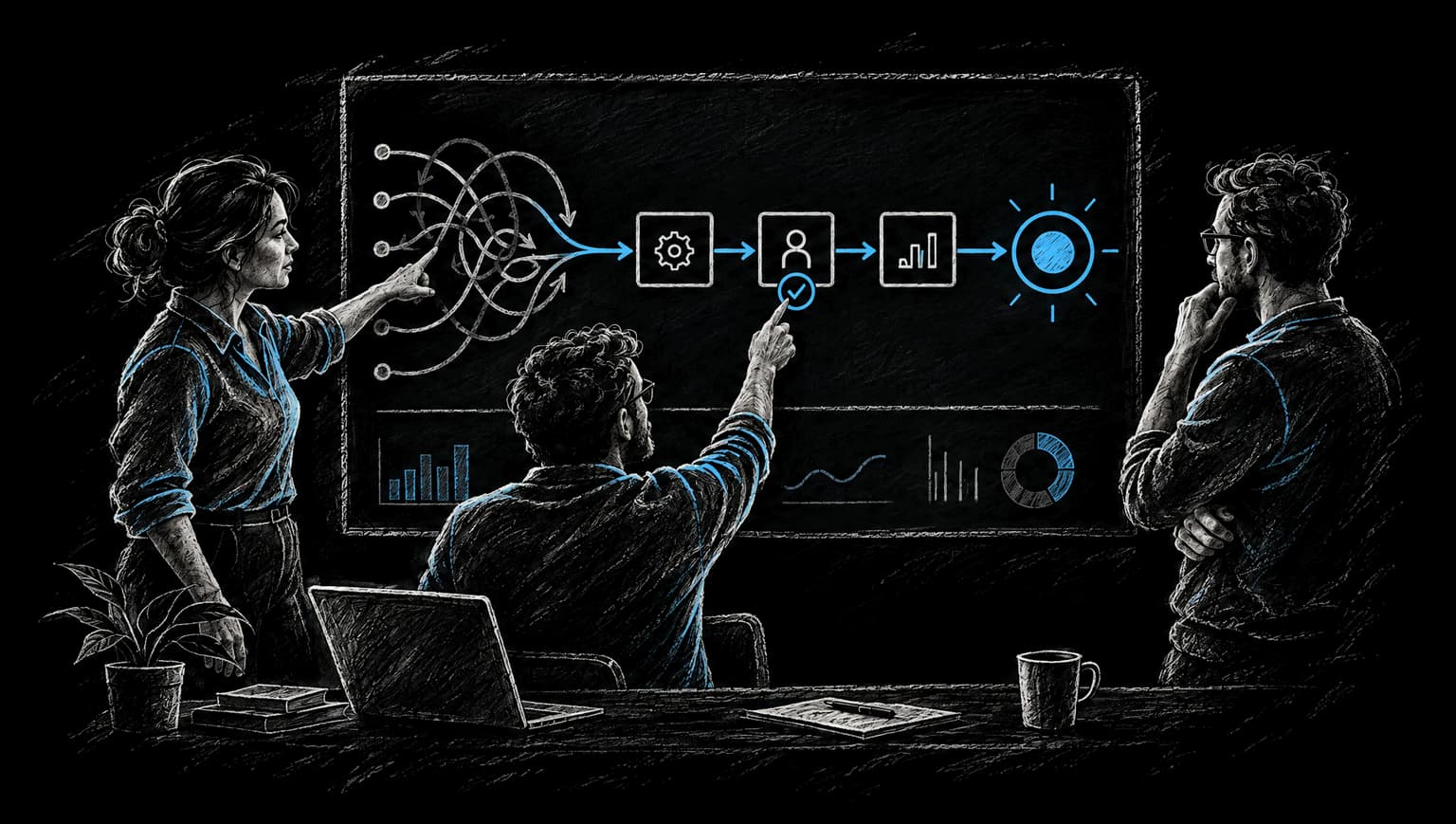
During discovery and planning, product and engineering aren't in separate rooms. They're asking questions together. What are we trying to change? What does success actually look like? What are the technical constraints? What do we not know yet? The output isn't a spec. It's shared clarity. Everyone in the room understands not just what they're building, but why.
During design and estimation, engineers push back not because they don't want to build something, but because they understand intent and can spot misalignment. A product leader says "we need to show this data in real time for 100,000 concurrent users." An engineer asks "what problem are we solving that requires real-time updates?" The answer might be "we're not sure." That's valuable information, not obstruction. Now the team can investigate instead of building the wrong infrastructure.
During development, the engineering team isn't following a spec like a recipe. They're shipping toward intent. If they discover a simpler path that still solves the problem, they take it. If they discover the initial understanding was wrong, they escalate immediately, not when code review happens. The team operates with forward visibility, not rear-view mirror feedback.
During delivery and measurement, the team validates against the original intent. Did we move the metric? Did customer behavior change the way we expected? If not, the conversation isn't "why did you ship something broken." It's "what did we misunderstand, and what does that tell us to build next?"
This is where many teams fail with AI-assisted development. The tooling makes it cheap to ship code. It's not cheap to ship wrong code. Pro-Neering keeps the clarity intact even as the velocity increases.
The Role of the PDL
Every Express Pod and Build Pod includes a Product Delivery Lead, the role that puts Pro-Neering into practice. A Product Delivery Lead is accountable for the outcome, managing intent, milestones, and the rhythm of delivery across the engagement. In practice, the PDL holds clarity, translates between business intent and technical execution, removes blockers, and keeps the team aligned on outcomes, not just output.
This isn't a bottleneck. It's a translator. The PDL bridges the gap between what the business needs and what engineering can build, so both sides can move fast without misalignment.
Pro-Neering and CRAFT
CRAFT (Context, Rationale, Automate, Fortify, Telemetry) is InTech's operating system, the governance underneath strategy, product engineering and managed operations. Pro-Neering is the philosophy behind it. Each element of CRAFT puts one part of Pro-Neering into practice: Context captures shared understanding. Rationale documents the why, not just the what. Automate eliminates manual work so the team can focus on intent. Fortify builds quality and reliability into delivery. Telemetry measures outcomes, not just output.
CRAFT is how Pro-Neering becomes repeatable, scalable, and measurable.
Common Questions About Pro-Neering
Does Pro-Neering mean product and engineering need the same skills?
No. Product leaders and engineers have different expertise. Pro-Neering means they work together from the beginning instead of sequentially. A product leader doesn't need to code. An engineer doesn't need to make business strategy. But they need to understand each other's constraints and bring those constraints into decisions from day one.
How does Pro-Neering work with remote or distributed teams?
The distance doesn't matter. What matters is communication cadence and clarity. Remote teams that are disciplined about shared understanding often operate with more Pro-Neering alignment than co-located teams that assume telepathy instead of explicit conversation. InTech is one team delivering from several regions, including the United States and Latin America, with shared context and overlapping US business hours, and Pro-Neering scales well across distance because it forces clarity rather than relying on hallway conversations.
Does Pro-Neering add overhead?
Not if done right. The conversations that build clarity happen anyway. Pro-Neering just structures them differently. Instead of discovering misalignment halfway through a sprint, it surfaces early. That saves time. Instead of rework that destroys momentum, clarity prevents the rework. Most teams find that proper alignment reduces overhead significantly.
How does AI-assisted development fit into Pro-Neering?
AI is a force multiplier on clarity. If the team knows exactly what they're building and why, AI tools can execute dramatically faster. If the team is vague, AI just produces vague code faster. Pro-Neering ensures the clarity exists before the AI does the work.
Can we adopt Pro-Neering without changing our entire process?
Yes. You don't need to overhaul everything. Start with shared intent conversations. Bring product and engineering into planning together. Measure outcomes, not just output. Small changes compound. Many teams find that even basic Pro-Neering practices eliminate their biggest sources of rework and misalignment.
What happens when product and engineering disagree?
That's normal. Pro-Neering doesn't eliminate disagreement. It structures how disagreement surfaces and gets resolved. When both sides understand the intent and constraints, disagreements become technical rather than political. You're debating the best path toward a shared goal, not arguing past each other from different goals.
From Friction to Proof
Bring us the part that’s getting in the way.
Tell our AI agent what you want to improve. We’ll help you find a useful first step.
Start with our AI agent. Find your next step.