Industries
AI for Staffing and Recruiting Agencies
Bridge ATS, CRM, payroll, and compliance systems so recruiters spend less time on data hygiene and more time placing candidates.
Start with our AI agent. Find your next step.
Staffing and Recruiting
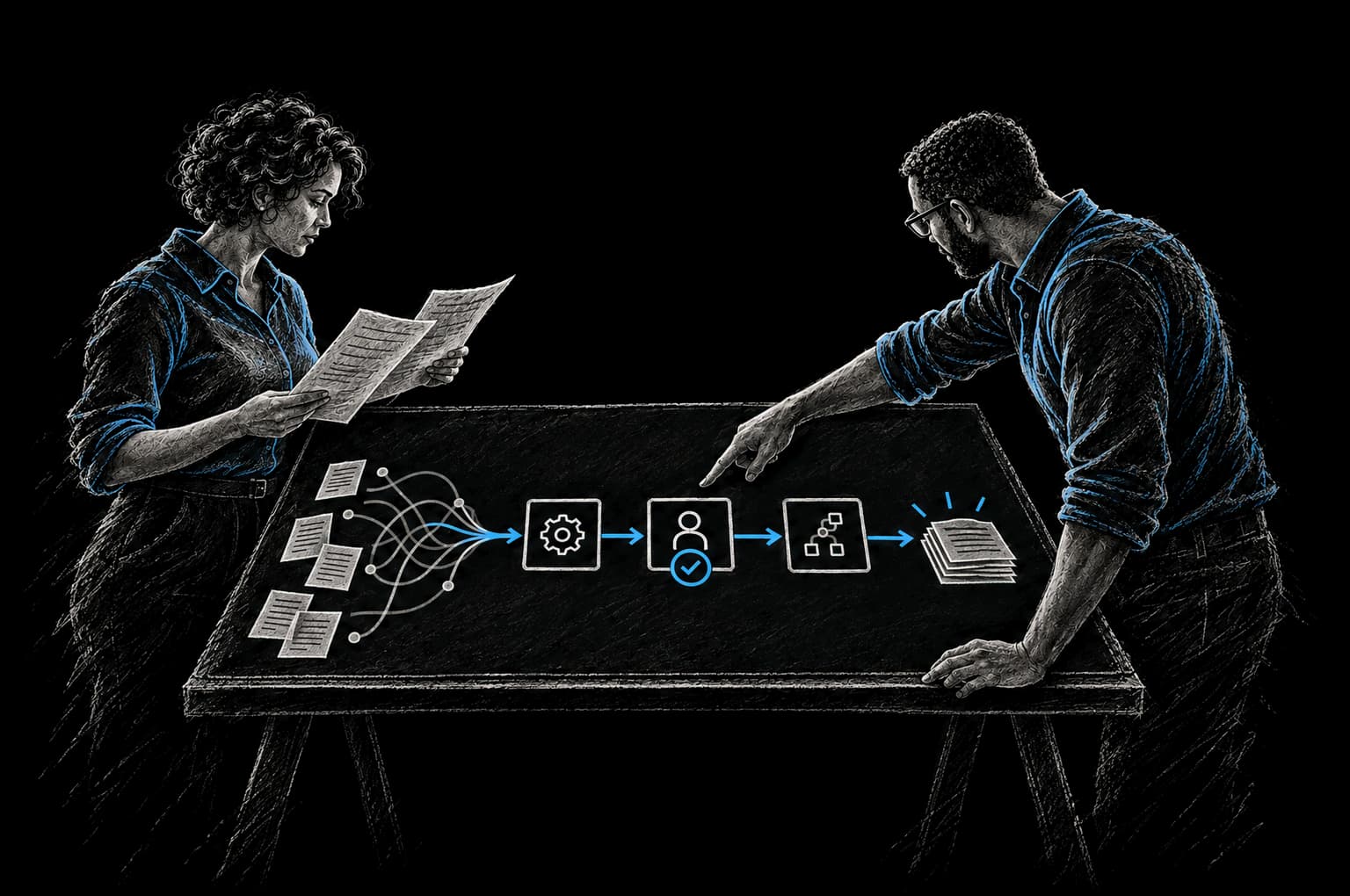
Recruiters keep the relationship work
- Match candidates to requisitions
- Draft personalized outreach
- Route compliance and onboarding tasks
Staffing agencies run on three currencies: speed to fit, quality of match, and consistency of compliance. The agencies that win match faster without dropping quality and stay compliant without slowing down. The ones that lose are stuck in ATS-CRM-payroll fragmentation, with recruiters spending much of their day on data hygiene instead of placements.
AI for staffing agencies is the operating layer that handles the matching volume, drafts the outreach, and keeps compliance routing on rails. Done right, recruiters spend their time on the conversations that close placements. Done wrong, AI introduces matching errors and compliance gaps.
What AI for staffing agencies means in practice
AI for staffing agencies is the integration of supervised AI agents into the workflows where recruiters lose the most time. The agents filter requisitions against candidate profiles, draft personalized outreach, route compliance reminders, and compile placement reports. Humans review and ship.
A complete AI for staffing engagement covers four pieces:
- ATS-CRM-payroll integration so agents read and write across all three systems
- Supervised candidate matching with approval gates on candidate-facing actions
- Compliance and onboarding workflow automation for checks, documents, and payroll handoffs
- Telemetry into match quality, response rates, and compliance status
This is different from buying an AI feature inside your ATS. Custom AI for staffing agencies reads across the full stack: ATS for candidates, CRM for clients, payroll for placements, and compliance systems for documentation.
The ATS-CRM-payroll fragmentation problem
The recurring operating problem in staffing agencies is that the three systems that should run the business do not talk to each other.
Candidate data lives in the ATS. Client relationships and open requisitions live in the CRM. Placement data, hours billed, and margin live in payroll. None of them share automatically.
The recruiter becomes the integration layer. They look up the candidate, check the requisition, confirm rate and term, draft outreach, and update three systems with what happened. AI for staffing fixes the integration first. The recruiter sees one unified view, and the data updates flow both directions.
This is the too many disconnected systems problem in its sharpest staffing form.
Where AI agents create leverage in staffing operations
Candidate-matching agents read open requisitions, filter ATS candidates against criteria, and surface top fits with reasoning.
Outreach drafting agents read candidate profiles, requisition specifics, and recruiter style, then draft personalized messages for review.
Compliance agents track background checks, drug tests, I-9 forms, certifications, and missing documents before they delay a start date.
Onboarding handoff agents compile payroll data, draft client onboarding communication, and route anything needing approval.
Reporting agents compile weekly placement summaries, time-to-fill metrics, and pipeline health for owner review.
How this differs from recruiting platforms
Recruiting platforms are built for in-house talent teams. Staffing agencies have a different operating problem: many clients, many requisitions, and an agency-owned candidate pool.
Agencies usually need a layer that connects their own ATS, CRM, payroll and compliance tools, and that is what we build.
How InTech builds AI for staffing
CRAFT (Context, Rationale, Automate, Fortify, Telemetry) is InTech's operating system, the governance underneath strategy, product engineering and managed operations. Pro-Neering is the philosophy behind it. Here is how it applies to a staffing agency.
Context starts with senior recruiters and back office. Rationale lives in the Intent Contract, with success metrics like time-to-fill, placements per recruiter, compliance pass rate, and candidate response rate.
Automate builds agents with bounded tool access across ATS, CRM, payroll, and communication platforms. Fortify catches missing documents, expired certifications, and pending checks. Telemetry gives owners visibility into what is being done in their name.
Engagement models: Express Pod and Build Pod
Most engagements start with an assessment that picks the first workflow. An Express Pod puts one measurable improvement into production in weeks, with the timeline agreed in the Intent Contract before build starts.
Most staffing agencies start with candidate matching or outreach drafting. A Build Pod expands the work once the first agent ships. For larger agencies integrating AI across the entire ATS-CRM-payroll stack, the Build Pod is configured for multiple workstreams. Once a workflow is live, InTech Operate can run and improve it.
Frequently asked questions
What does AI for staffing agencies actually do?
AI for staffing agencies handles the matching, outreach drafting, and compliance routing volume. Agents filter open requisitions against candidate profiles, surface top fits with reasoning, draft personalized outreach, and route compliance reminders. Recruiters keep the relationship work and the placement calls.
How is this different from AI recruiting platforms?
Recruiting platforms are built for in-house talent teams. Agencies usually need a layer that connects their own ATS, CRM, payroll and compliance tools, and that is what we build.
Will AI replace my recruiters?
No. AI replaces the matching and outreach volume, not the relationship and judgment work. Recruiters spend more time on the calls that close placements and less time on candidate-filtering busywork.
How do you handle candidate data privacy?
Agents run with bounded access in environments you approve. Candidate data goes only to services covered by your agreements (for example, your agreement with the model provider), and every agent action is logged. Approval gates on candidate-facing communications mean a recruiter reviews any outreach before it sends.
How long does it take to ship AI for a staffing agency?
An Express Pod puts one measurable improvement into production in weeks, with the timeline agreed in the Intent Contract before build starts. Most staffing agencies start with candidate matching or outreach drafting. A Build Pod expands the work as the approach proves out.
Related: methodology and AI Operating System context
From Friction to Proof
Bring us the part that’s getting in the way.
Tell our AI agent what you want to improve. We’ll help you find a useful first step.
Start with our AI agent. Find your next step.