Services
Custom AI Software for Businesses
Replace SaaS workarounds with software that matches how your team actually serves customers.
Start with our AI agent. Find your next step.
Delivery Snapshot
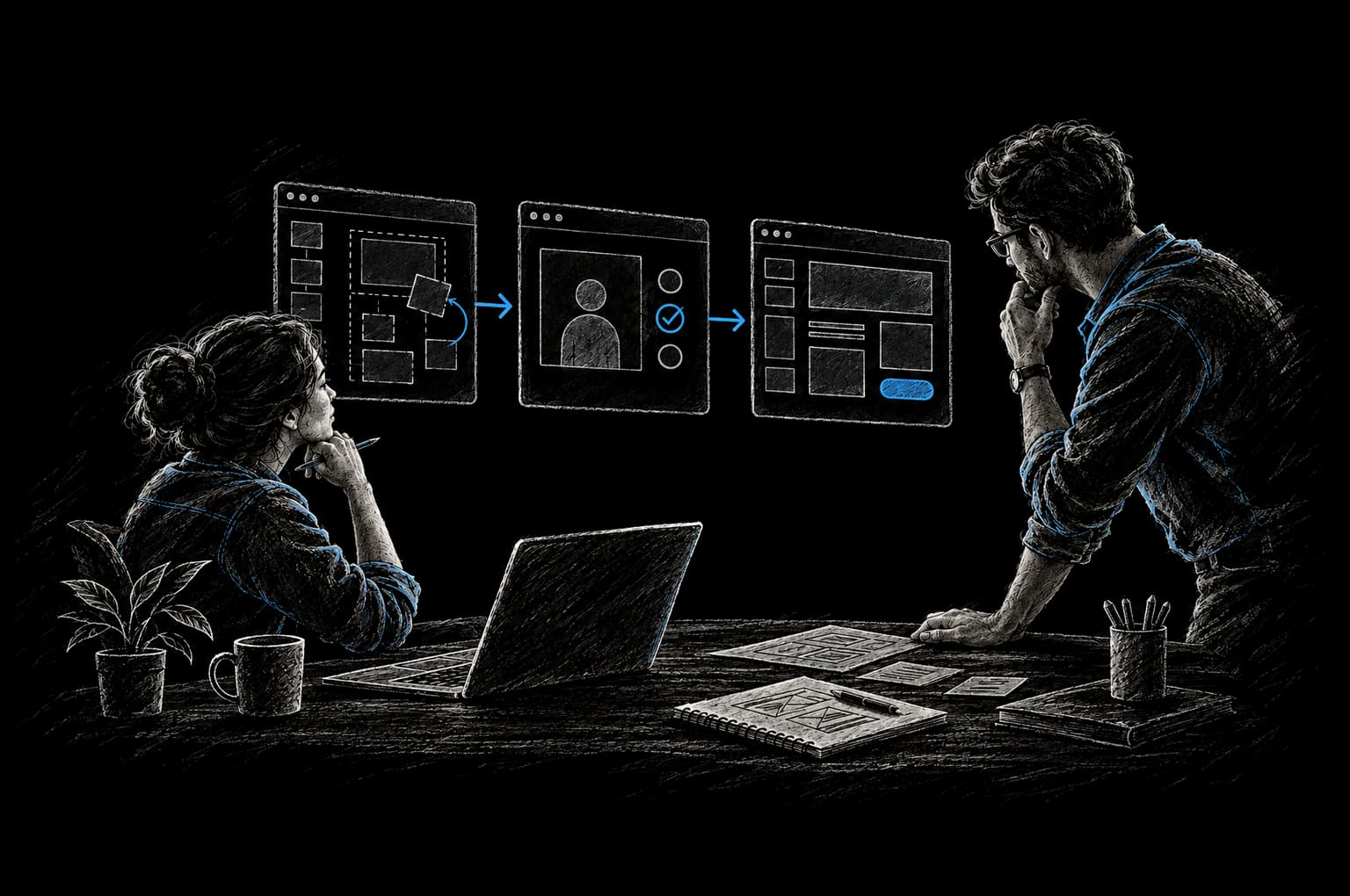
Software shaped around your operations
- Model the workflow your tools cannot support
- Build interfaces around your business rules
- Connect the system to the data your team already uses
Most businesses solve workflow problems by stacking SaaS tools. Each tool does one thing well. But when you connect them together, the seams show. Data doesn't flow the way your team works. Manual steps multiply. Reports require three exports and a spreadsheet. Teams end up building workarounds instead of doing their jobs.
That's where custom AI software makes sense.
Custom software isn't the default answer. SaaS is excellent when the workflow is standard and the tool is well-designed. But when your workflow is differentiated, fragmented across multiple tools, or constrained by what's available off the shelf, a custom solution can eliminate friction and embed your competitive advantage into your operations.
When Custom AI Software Is the Right Choice
Custom AI software earns its cost when one or more of these is true:
Your workflow is differentiated. How you operate is part of what makes you competitive. You can't afford to change your process to fit a SaaS product. A recruiting firm's sourcing methodology, a medical device manufacturer's quality workflow, or a consultancy's project delivery model each have unique logic that no generic tool captures. Custom software can encode that logic and scale it.
Off-the-shelf tools force compromise. You've found a tool that does 70% of what you need. Using it means retraining teams, changing processes, or accepting gaps. A custom system designed around your actual workflow eliminates these compromises.
You're cobbling together multiple SaaS tools. Your team uses six different systems to do what one connected platform could do. Data lives in three places. Integrations are fragile. The annual cost is higher than you'd expect. A unified system eliminates the connective friction.
You need AI embedded in a specific workflow. ChatGPT is great for general questions. But you need an AI assistant that works against your data, understands your business logic, and integrates with your existing systems. That's custom.
Your data model or integrations are unique. Your business has uncommon integration requirements, compliance constraints, or data structures that generic tools don't accommodate well. A custom build can reflect your reality instead of forcing you into a standard mold.
You've outgrown what SaaS can support. You're hitting the limits of a SaaS platform's customization or scalability. You're paying for features you don't use. The vendor's roadmap doesn't align with your needs. A custom build becomes more cost-effective than continuing to pay for compromise.
What Custom AI Software Is Not at InTech
We don't build vibe-coded prototypes that look impressive in a demo but can't scale. We don't create black-box systems that nobody on your team understands or can maintain. We don't treat custom software as a shortcut around engineering discipline.
Custom software requires discipline, integration planning, and maintainability from day one. If a project doesn't meet that bar, we'll tell you.
How It Compares to SaaS
The comparison isn't abstract. It's practical.
SaaS excels at standard workflows. If you're managing email, processing payroll, or running a basic CRM, a SaaS product is likely your best bet. It's lower risk, faster to implement, and you're not responsible for maintaining infrastructure.
Custom software earns its cost when the tradeoff shifts. According to Zylo's 2025 data (opens in a new tab), the average company uses 275 SaaS applications. Each one is solving a piece of the puzzle. The sprawl creates complexity. According to BetterCloud's 2025 research, 75% of employees acquire tech without IT approval, which signals that off-the-shelf tools aren't fully addressing what teams need.
The calculus isn't about SaaS being worse. It's about whether the available tools fit your workflow or whether your workflow requires something built for how you actually operate.
Common Scenarios for Custom AI Software
Business operating system. A consolidated platform that replaces spreadsheets and disconnected SaaS tools with a single system where data flows between operations, sales, delivery, and finance.
AI-assisted workflow automation. A system that automates triage, routing, task assignment, and exception handling for a specific operational process. Think loan origination, customer onboarding, or incident management where AI handles initial routing and humans handle exceptions.
Customer-facing portal or application. A branded system that integrates with your backend systems and lets customers do what they need without calling support or logging into multiple systems.
Internal AI assistant. An AI system that works against your company's data, processes, and business logic. Not ChatGPT for general questions, but an assistant that understands your context and helps your team work faster.
Product extension for SaaS companies. Adding an AI capability to your existing platform that enhances value without requiring your customers to leave your ecosystem.
MVP to test a new product concept. A custom build that tests a business idea before committing to a larger investment. Faster and cheaper than hiring a permanent team. Real engineering discipline, not a throwaway prototype.
How InTech Approaches Custom AI Software
We start with an Intent Contract. An Intent Contract is a short, signed-off statement of the outcome, scope, success metrics, constraints, human authority boundaries and acceptance criteria. It is not a legal agreement; commercial terms live in the engagement agreement. Before code is written, it makes clear what we're building, why, what success looks like, and what happens if requirements shift. It's how we stay aligned.
We use CRAFT. CRAFT (Context, Rationale, Automate, Fortify, Telemetry) is InTech's operating system, the governance underneath strategy, product engineering and managed operations. Pro-Neering is the philosophy behind it. In practice, that means disciplined engineering from day one. Code that works, code that scales, code that your team can maintain and evolve. Not shortcuts. Not technical debt disguised as velocity.
Your infrastructure, your lock-in protection. You own the code, repositories and infrastructure we build for you. What you own at the end of an engagement is set out in your MSA and explained in What You Own and What We Keep. We build in your accounts, not ours, and we don't lock anything in. You can migrate it, modify it, or bring in another team. That's how it should work.
We work in pods. Not a hiring agreement. Not vague retainers. Clear deliverables, clear timelines, clear outcomes.
Delivery Models
Express Pod: One Measurable Improvement. An Express Pod puts one measurable improvement into production in weeks, with the timeline agreed in the Intent Contract before build starts. Focused scope. Real deliverable. Validate a concept or solve a specific workflow problem. Not a toy. Engineering discipline, smaller scope.
Build Pod: Ongoing Development. The Build Pod is ongoing delivery capacity with a Product Delivery Lead, staffed to the shape of the work and managed against outcomes. Commercial terms are agreed per engagement. For teams building something that needs to grow over time: new features, integration, optimization.
Build Pod, Multi-Workstream Configuration. For organizations building something substantial. More engineers and parallel workstreams, faster iteration, and a deeper product partnership, all under the same accountability model, with Product Delivery Leads accountable across the streams.
All pods include dedicated engineering, architectural design, integration planning, and a Product Delivery Lead. A Product Delivery Lead is accountable for the outcome, managing intent, milestones, and the rhythm of delivery across the engagement. Your infrastructure, and a clear price before work starts.
Questions Teams Ask
How is this different from hiring a freelancer or agency?
Freelancers are typically solo contributors. Agencies often rotate engineers between clients, so context and quality vary. InTech is one accountable team, working in US hours, under a defined methodology (CRAFT). You're getting a dedicated pod, not a marketplace connection.
What if we don't know exactly what we need?
That's normal. The Intent Contract conversation is designed for that. We ask questions about your workflow, your pain points, and your constraints. We identify what's actually custom and what might be better solved with SaaS. We design the MVP together, then build it. You see what you're getting as it's built.
How long does a custom build take?
It depends on scope. An Express Pod puts one measurable improvement into production in weeks, with the timeline agreed in the Intent Contract before build starts. A larger system, such as a consolidated business platform, is delivered in stages through a Build Pod, single or multi-workstream, with the timeline for each stage agreed before work on it starts. We're clear about timeline early and we protect it.
What about maintenance and updates?
You own the code, repositories and infrastructure we build for you, and we document as we build so your team can understand and modify the code. From there, your team can run the system, a Build Pod can keep developing it, or InTech Operate can run and improve it as a managed service, with the same evaluations and telemetry. You can also bring in another team.
Can you integrate with our existing systems?
Yes. Integration planning is part of the methodology. If you're pulling data from Salesforce, Stripe, your accounting system, or a custom database, we design the integration to be reliable and maintainable. API keys and webhooks don't scare us.
What if it's a bad idea?
We'll tell you. If custom software isn't the right answer, we're honest about it. If a SaaS product solves the problem better, we'll say so. Our goal is to help you make the right decision, not to sell you something you don't need.
From Friction to Proof
Bring us the part that’s getting in the way.
Tell our AI agent what you want to improve. We’ll help you find a useful first step.
Start with our AI agent. Find your next step.