AI Operating Systems
AI Operating Systems for Business
Connect data, workflows, AI, and visibility so the business runs as one coordinated system.
Start with our AI agent. Find your next step.
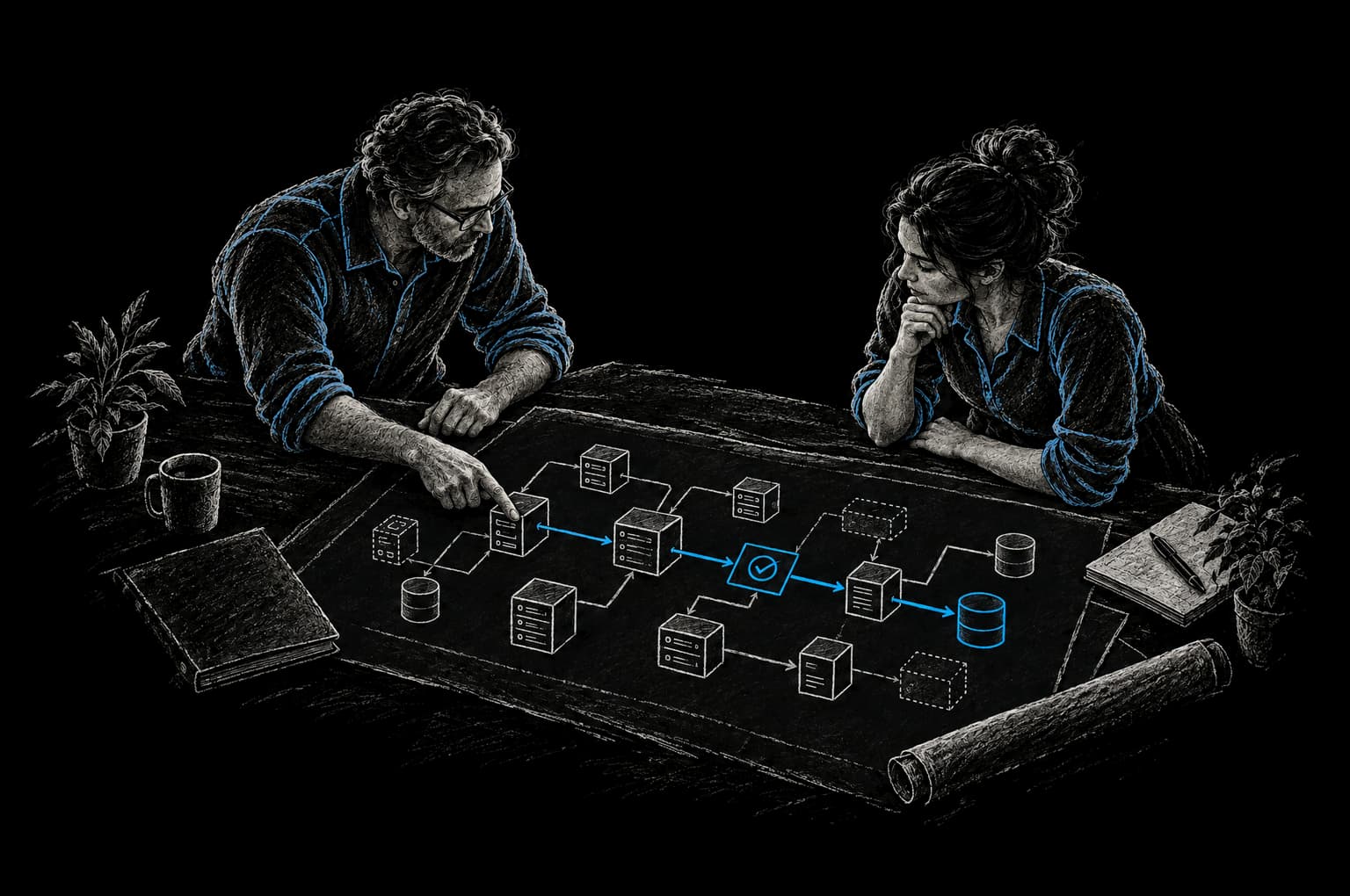
Operating System Lens
The operating layer
- Connect critical systems of record
- Make workflows explicit and measurable
- Put AI inside the operating flow
What Is an AI Operating System?
An AI Operating System is the connected software, data, workflow, and automation layer that helps a business run with more visibility and leverage. It is not a literal computer operating system and not a single platform. Instead, it is the coherent integration of your business's critical workflows, data sources, and intelligent automation that replaces fragmented spreadsheets, inboxes, manual handoffs, and tribal knowledge with a system where work moves faster and smarter.
Most organizations operate like a loosely coupled network of tools and processes. Finance uses one system, operations uses another, customer service uses a third. Information gets copied between them by hand. Decisions wait for email threads to resolve. Exceptions go unnoticed until they become crises. An AI Operating System bridges these islands and makes the business visible and responsive.
Why the Term Matters Now
The concept of an operating system traditionally refers to the software layer that coordinates hardware resources and allows applications to run. We're using the same metaphor for business operations. Just as an OS manages CPU, memory, and I/O to make a computer work, an AI Operating System manages data, workflows, and intelligence to make a business work better.
The timing matters. Most businesses have digitized their functions over the past decade: they have a CRM, an accounting system, HR software, project management tools. But these systems were built independently. They don't talk to each other well. Data gets duplicated, outdated, or lost in translation. Decisions are slow because information is scattered.
Simultaneously, AI has reached a maturity level where it can do real work. Not just analysis or recommendations, but automation, routing, summarization, exception detection, and decision support. The missing piece is not AI capability. It is the connected data and workflow foundation that makes AI useful and safe. AI integration services build that foundation across the systems your teams already use.
An AI Operating System is the answer to this gap. It is what you build when you decide to stop treating your software stack as a collection of point tools and start treating it as a coordinated system designed to improve how work moves through your organization.
The Business Case
The cost of fragmentation is measurable and urgent.
According to IBM research (opens in a new tab), poor data quality costs U.S. businesses approximately 3.1 trillion dollars annually. Duplicated data entry, manual reconciliation, decisions made on incomplete information, and opportunities missed because the right person didn't have the right context all flow from this fundamental problem.
The adoption gap is equally stark. McKinsey's State of AI 2025 found (opens in a new tab) that 78% of organizations use AI in at least one business function. Yet 80% report no clear bottom-line effect. In our experience, a common reason is the foundation, not the AI. You cannot generate real value from AI if your data is inconsistent, your workflows are manual, and your teams lack visibility.
Consider the average company's technology footprint. Zylo reports that companies now use between 106 and 275 SaaS applications. Each one captures some data. Few of them share it cleanly. This is the operating environment most businesses face.
But there is a clear path forward. McKinsey found (opens in a new tab) data-driven organizations are 23 times more likely to acquire customers, six times as likely to retain them, and 19 times as likely to be profitable. Connected, usable data is not a technology cost. It is a competitive advantage.
Core Components of an AI Operating System
An AI Operating System has four layers. Each must be present and connected.
Data layer. Your data must be connected, clean, and accessible. This does not mean a single database. It means your critical business information flows through defined, governed pathways. When a customer is added to your CRM, that fact propagates to billing. When inventory moves, that update reaches fulfillment and finance. When a deal closes, the information reaches success, support, and renewals. Consistency comes from intentional architecture, not from hoping people copy data correctly.
Workflow layer. Workflows are the sequences of steps that move work through your business. In most organizations, workflows are implicit and manual. A lead comes in. Someone opens a spreadsheet and moves it to the next owner. A project starts. Someone sends emails to notify relevant people. An invoice is sent. Someone follows up manually if it is not paid. An AI Operating System makes workflows explicit and automates the moves. Work flows from person to person and system to system without manual handoff. Bottlenecks become visible because the system can measure them.
AI layer. This is where intelligence operates. AI can route work to the right person based on skill and capacity. It can summarize information from multiple sources so operators do not have to read ten emails to understand context. It can flag exceptions and variations that humans would miss. It can generate recommendations for next steps. It can reduce the cognitive load of decision-making. But AI is only as good as the data and workflows it operates on.
Visibility layer. Operators need real-time clarity on what is happening. Dashboards, alerts, reports, and snapshots give visibility into bottlenecks, exceptions, progress toward goals, and anomalies. This is not about vanity metrics. It is about giving the people running the business the information they need to make quick, good decisions.
These four layers work together. Weak data makes workflows break and AI unreliable. Manual workflows hide the information you need for visibility. Poor visibility means problems compound before anyone notices. These are not independent projects. They are facets of a single operating system.
AI Operating Systems Across Industries
The concept is abstract until you see it in motion. Here are patterns that recur across different business types.
A medical supply company receives orders through multiple channels: direct from hospitals, through group purchasing organizations, through a website. Inventory is tracked across multiple warehouses. Customer communication happens via email, phone, and a portal. Fulfillment teams coordinate with logistics partners. Billing and accounts receivable is separate. An AI Operating System would connect these islands. Orders would flow consistently from entry to fulfillment to billing. Inventory changes would propagate immediately to availability and to replenishment logic. Customer communication would have full context of order history, shipments, and billing status. AI could route urgent orders to priority fulfillment, flag backorder risks, and automatically generate follow-up communication.
A concierge medical practice has a different set of challenges. Patients call, email, or use a portal to request appointments. Intake forms are paper and scattered. Providers need complete patient history before visits. Follow-up communication often falls through cracks. Appointment availability is managed manually across a fragmented calendar system. An AI Operating System would unify intake, scheduling, provider communication, and patient outreach. New patients would complete intake once and have that data available to all providers. Scheduling would have real-time provider availability and patient preferences. AI could send appointment reminders, flag no-shows, and generate follow-up plans based on visit notes.
A staffing agency manages job orders, candidates, clients, onboarding, and compliance across multiple systems. Candidate data lives in the ATS. Client relationships live in the CRM. Background checks, onboarding documents, and payroll handoffs happen in separate tools. An AI Operating System would connect these layers. Candidate information would sync across recruiting, onboarding, and billing workflows. Open roles would surface better-fit candidates faster. Compliance reminders, client updates, and placement handoffs would run with complete context.
A professional services firm manages leads, proposals, delivery, and client follow-up. Leads come from multiple sources and are tracked inconsistently. Proposals are built from templates but lack clarity on probability. Delivery is tracked against budget, but changes to scope are not automatically reflected in profitability tracking. Client follow-up is informal. An AI Operating System would give the leadership team visibility across the entire pipeline. Proposals would be generated with high-quality context. Delivery would be transparent in real time. AI could flag projects at risk of overrun and recommend proactive client outreach.
A field service company dispatches technicians, manages job scheduling, collects updates from the field, and handles invoicing. Dispatch is fragmented. Technician status updates are delayed. Invoicing is separated from job completion. Customers have limited visibility into when their service will arrive. An AI Operating System would connect scheduling, field status, customer communication, and billing. Dispatch would be optimized based on real-time location and capacity. Customers would have live updates on technician arrival. Invoicing would be automated when jobs are completed and photos are submitted.
In each case, the AI Operating System is not a replacement for the business. It is the coordination layer that makes the business run faster, with fewer errors, and with better visibility.
When the need is narrower than a full operating-system engagement, an AI automation consultant engagement can ship one focused workflow first and expand from there.
Common Mistakes to Avoid
Many organizations attempt to build an AI Operating System but fail because they skip foundational steps.
Adding AI to broken processes. The most common mistake is automating a workflow without first clarifying what it should be. If a process is manual because it is broken or because no one has clarity on the intended outcome, automating it will simply scale the problem. Before you automate, be clear on intent. What should happen? Why? Who should do it? What information do they need? An AI Operating System requires clarity first, code second.
Treating data as optional. An organization will sometimes attempt to add AI and automation without first connecting and cleaning data. This is backwards. Poor data is the constraint. AI cannot make decisions on bad information. Data quality is not a technical problem to solve later. It is a business problem to solve first. Your AI Operating System must be built on a foundation of clean, connected data.
Building it as a one-time project. An AI Operating System is not a product launch. It is a capability that evolves. The initial build might connect your top three workflows and give you visibility across your core data. But the system improves over time as you add workflows, refine automations, and respond to what you learn about your business. Organizations that treat this as a one-time migration often fail because the system becomes outdated and its maintenance falls to an overworked team. The right model is ongoing iteration.
Losing sight of business outcome. It is easy to become absorbed in the technical elegance of the system. But an AI Operating System is a means, not an end. The goal is a measurable improvement in business performance: faster cycle time, fewer errors, better customer experience, improved margins, or clearer visibility for decision-making. If you are building technical infrastructure without tying it to a business outcome, you will lose stakeholder support when budget gets tight.
How InTech Builds AI Operating Systems
CRAFT (Context, Rationale, Automate, Fortify, Telemetry) is InTech's operating system, the governance underneath strategy, product engineering and managed operations. Pro-Neering is the philosophy behind it: clarity before code, and intent before features.
The process starts with Context. We spend time understanding your business operation deeply. Where is work flowing? Where are bottlenecks? What decisions are slow? What information is duplicated or missing? Where does tribal knowledge hide critical business logic? This is not a technology assessment. It is a business operation assessment. We come out with clarity on what matters most.
From that clarity, we establish Rationale. We agree on what an improvement would look like. What workflows matter most? What data integration would unlock value? What visibility would change how you operate? We are explicit about the business outcome we are pursuing. This prevents drift and ensures alignment across the organization.
Then we Automate. We build the data connections, workflows, and AI integrations that move you toward that outcome. We move purposefully. We do not boil the ocean. We deliver in stages so you can learn and adjust.
We Fortify by building in reliability, error handling, and safeguards. An AI Operating System that works 90% of the time becomes a trust problem. It must be dependable.
Finally, we establish Telemetry. We instrument the system so you can see it working. Dashboards, alerts, and logs give you visibility into whether the system is performing as intended and where further improvement is needed.
This work is delivered through two pod configurations plus an operating relationship. An Express Pod puts one measurable improvement into production in weeks, with the timeline agreed in the Intent Contract before build starts. The Build Pod is ongoing delivery capacity with a Product Delivery Lead, staffed to the shape of the work and managed against outcomes. Commercial terms are agreed per engagement. The Build Pod expands and improves the operating system, and it is configured for multiple workstreams when several areas of the business move in parallel. InTech Operate runs and improves the system in production as a managed service. Most new engagements start with a fixed-scope assessment, then move into an Express Pod to prove the approach on one workflow. From there they move into a Build Pod or InTech Operate depending on pace and ambition.
Frequently Asked Questions
Is an AI Operating System the same as an ERP system?
No. An ERP system is a monolithic platform designed to replace many point tools. An AI Operating System integrates across your existing tools and adds coordination, workflow, and intelligence. You can keep your CRM, your accounting system, your project management tool, and your custom applications. An AI Operating System connects them and makes them work together coherently.
Do we need to migrate all our data to build an AI Operating System?
Not necessarily. You often need to clean and standardize data, but you do not need to migrate it all to a single platform. APIs, ETL pipelines, and data synchronization tools can connect data across multiple systems. The goal is accessibility and consistency, not consolidation to a single database.
Can we build this in-house?
Yes, you can. You have engineers and domain expertise. But building an AI Operating System requires thinking across business operations, data architecture, workflow design, and AI integration simultaneously. Most organizations benefit from external guidance to accelerate the work, avoid common pitfalls, and establish the right foundation. InTech combines deep domain experience with hands-on delivery.
How long does it take?
That depends on scope and complexity. An Express Pod puts one measurable improvement into production in weeks, with the timeline agreed in the Intent Contract before build starts. A comprehensive operating system that reaches across many workflows and integrates multiple data sources might take three to six months. The best approach is to start with one workflow and expand from there based on what you learn.
What is the cost?
Cost depends on the number of systems and the complexity of the workflow. We scope it after an assessment and give you a clear price before work starts. The better question is the value unlocked. We build the business case with you from your own baseline, so you can see the expected payback before you commit.
What if we have legacy systems we cannot replace?
Legacy systems are common and often hold critical business logic. An AI Operating System does not require you to replace them. It works by creating connectors and orchestration layers that bridge legacy systems with modern tools and workflows. You keep what works and coordinate it with what is new.
How do we measure whether it is working?
Define success metrics upfront. These might include time saved on manual processes, reduction in data errors, improvement in cycle time, better customer communication, or clearer visibility on key business metrics. Telemetry should track these. The Intent Contract sets the baseline and the date we verify against, so you can see whether the system is moving the numbers.
From Friction to Proof
Bring us the part that’s getting in the way.
Tell our AI agent what you want to improve. We’ll help you find a useful first step.
Start with our AI agent. Find your next step.