Methodology
How InTech Builds AI Software
AI speeds up the build. Engineers keep the judgment, the architecture, and the quality gates, under CRAFT.
Start with our AI agent. Find your next step.
Methodology
What this helps you do
- Tell AI-assisted work from AI-generated code
- See how CRAFT governs each stage of the build
- Know who builds your software and what you own
There's a difference between code that happens to be generated by AI and software that works. The first cuts corners on architecture, skips security reviews, and produces technical debt that compounds. The second treats AI as an accelerant within a disciplined engineering process, where every output from an AI tool gets evaluated by a human engineer for correctness, security, and maintainability.
InTech doesn't practice AI-generated code. We practice AI-assisted development (opens in a new tab). And that distinction changes everything about what ships.
The Problem With AI-Generated Code
Every day, teams spin up ChatGPT, prompt it for a feature, copy the output into their codebase, and call it done. It feels fast. And it is, until the database schema breaks under load, or the authentication logic has a vulnerability that takes three weeks to debug, or the code is so opaque that nobody can modify it six months later.
The real cost of AI-generated code isn't the time saved upfront. It's the debt incurred: unmaintainable architecture, missing error handling, third-party integrations chosen for convenience instead of fit, no observability, and no documented reasoning for the decisions made.
When someone on your team inevitably needs to modify that code, they're starting from scratch because nothing was recorded about why it was built the way it was.
InTech's approach is different. We use AI tools to handle scaffolding, boilerplate, first drafts of functions, and test generation. But an experienced engineer reviews every single output before it goes into your codebase. That engineer owns the architecture, the security posture, and the long-term maintainability. AI accelerates execution. Humans exercise judgment.
How InTech Builds AI Software: The CRAFT Process
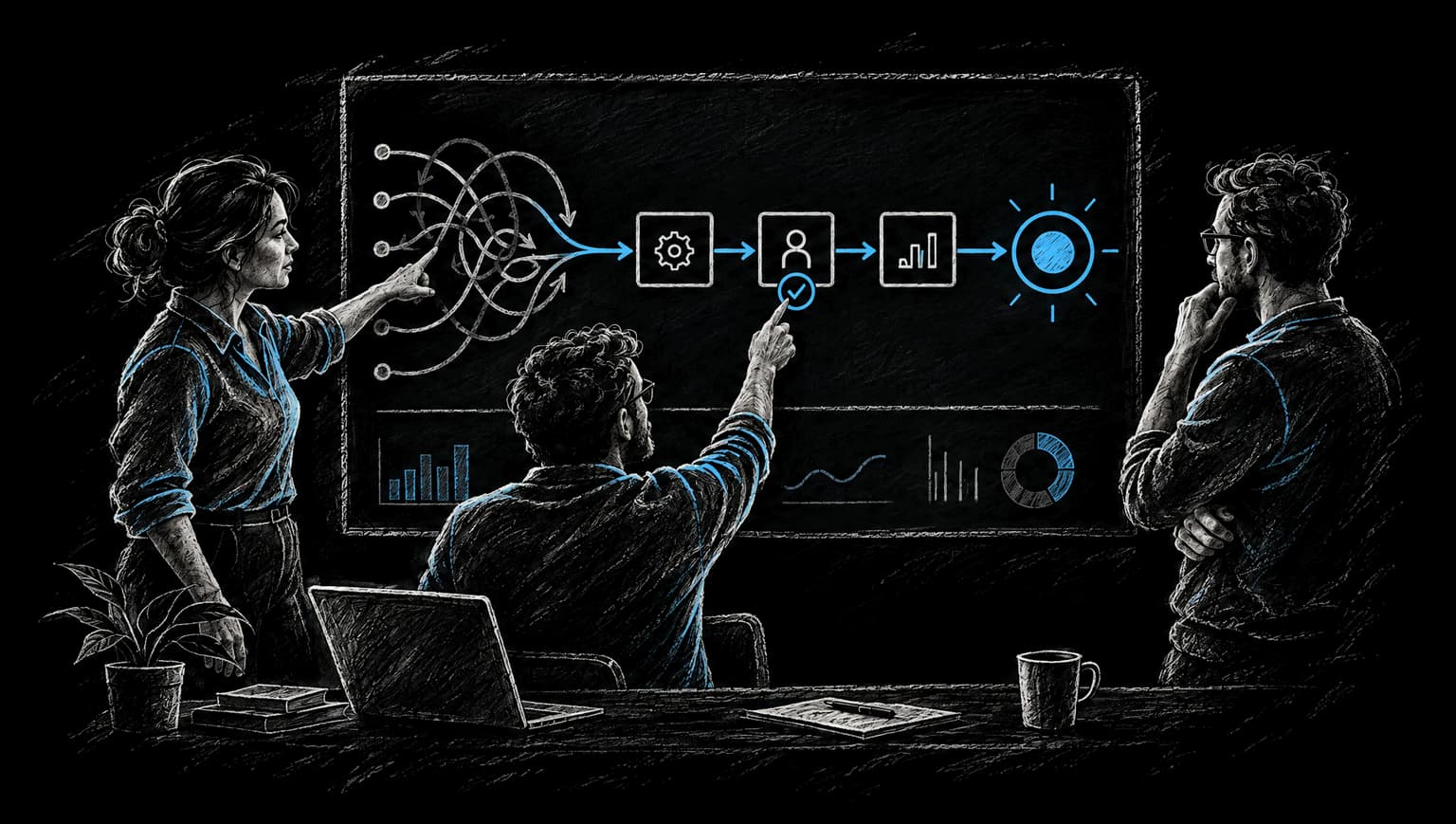
CRAFT (Context, Rationale, Automate, Fortify, Telemetry) is InTech's operating system, the governance underneath strategy, product engineering and managed operations. Pro-Neering is the philosophy behind it. In the build, CRAFT is designed to catch the gaps that AI-generated code leaves wide open.
Context First
Before a line of code is written, InTech establishes a shared understanding of what's actually being built and why. This happens through an Intent Contract. An Intent Contract is a short, signed-off statement of the outcome, scope, success metrics, constraints, human authority boundaries and acceptance criteria. It is not a legal agreement; commercial terms live in the engagement agreement.
An Intent Contract isn't a requirements document. It's a north star. It's what keeps a project from drifting into feature bloat or solving the wrong problem. When the team gets stuck on a technical decision, they reference the Intent Contract to decide whether a particular approach serves the outcome metric or not.
This phase prevents the first expensive mistake: building the wrong thing fast.
Rationale Documented
Every material technical decision (architecture choice, data model, third-party integration, authentication approach) gets recorded in a Decision Record. Not just the decision, but the reasoning: why this option was chosen, what alternatives were evaluated, what constraints drove the choice.
Decision Records serve two purposes. First, they force clear thinking at the moment a decision is made. Second, they prevent the same decisions from being relitigated six months later when someone asks "why did we build it this way?"
When AI generates code that makes an architectural assumption, a Decision Record explains why that assumption holds, or whether it needs to be reconsidered. Without that record, future engineers are either blocked or forced to guess.
Automate With Oversight
This is where AI tools enter the process. Prompts are precise because the requirements are clear and documented. AI generates function stubs, scaffolding, test cases, and routine code. Engineers review the output for correctness, security implications, performance characteristics, and alignment with the documented architecture.
Automation is risk-proportional. Generating a utility function gets light-touch review. Designing the authentication flow gets rigorous evaluation. The riskier the code, the more human judgment it receives.
Fortify Before Shipping
Quality gates are mandatory, not optional. Before code ships, tests must pass. The rollback path must be validated in a staging environment. Environment variables must be securely managed. Observability must be live: if something breaks in production, your team will know within minutes. QA sign-off isn't a courtesy; it's a gate.
"It feels ready" is not a sufficient quality standard when you're running production software that people depend on. Fortify ensures that what leaves the pod is actually ready.
Telemetry From Day One
Success isn't measured by deployment date. It's measured against the outcome metric defined in the Intent Contract, observed through live telemetry post-launch. Thirty days after launch, the team reviews that telemetry: is the feature actually reducing customer friction? Is it being used the way we expected? What broke that we didn't anticipate?
This closes the loop. What you learn from telemetry informs the next iteration, the next Decision Record, the next Intent Contract.
The Pod Model: Who Builds Your Software
We staff dedicated pods, not freelancers: integrated teams that own the outcome.
A pod includes dedicated engineers, a Product Delivery Lead, and QA, DevOps, and UI/UX support proportional to the product's needs. A Product Delivery Lead is accountable for the outcome, managing intent, milestones, and the rhythm of delivery across the engagement. One accountable team stays responsible for your product, specialists join as needed, and context carries forward in the Context Graph and Decision Records. We take responsibility for code quality. You own the code and the infrastructure.
InTech offers two pod configurations:
Express Pod. An Express Pod puts one measurable improvement into production in weeks, with the timeline agreed in the Intent Contract before build starts. It takes a single, well-defined constraint through four stages (Align, Build, Verify, and Prove), so feasibility, usefulness, adoption, and supportability are demonstrated rather than assumed. This model is for teams that need production evidence before committing to sustained delivery.
Build Pod. The Build Pod is ongoing delivery capacity with a Product Delivery Lead, staffed to the shape of the work and managed against outcomes. Commercial terms are agreed per engagement. This works for teams that have a clear product direction and need sustained engineering capability to execute a roadmap.
For larger products with multiple workstreams, or teams that need to move faster across a complex roadmap, the Build Pod is configured for multiple workstreams, under the same accountability model.
All infrastructure is set up from day one in your repositories and your cloud accounts (AWS, GCP, Azure, Vercel, Railway, Supabase, or whatever you already use). You own the keys. You're never dependent on InTech-managed accounts or integrations.
What You Receive
An InTech pod delivers more than code. You receive a documented, maintainable codebase with decision rationale embedded throughout. You receive Intent Contracts that clarify strategy. You receive one team delivering from several regions, including the United States and Latin America, with shared context and overlapping US business hours. You receive weekly progress visibility and a clear runway to each milestone.
You get a codebase that your own team can understand, modify, and run. You're not paying for technical debt in disguise.
FAQ
Does AI-assisted development mean the code is less reliable?
No. AI generates code quickly, but without human judgment, it often misses security implications, scalability concerns, and architectural coherence. InTech's approach inverts this: AI handles routine coding tasks fast, and engineers focus their attention on the decisions that matter most, the ones that determine whether the system is secure, scalable, and maintainable. The result is code that meets the same review, security and quality gates as code a senior engineer writes by hand.
What if we have existing code we want to integrate with?
That's normal. The pod inherits your existing codebase, understands its architecture and constraints, and extends it according to your roadmap. Decision Records are created for integration choices. The goal is a coherent codebase, not a system where old code and new code follow different patterns.
How much involvement do we need to have?
You need to be available for clarity on the Intent Contract and for feedback during each phase. The Product Delivery Lead will schedule weekly syncs and flag blockers early. Expect an hour or two per week during active build phases. If you're hands-off entirely, the pod can't validate that it's building the right thing.
Can we switch engineers mid-project?
We staff dedicated pods, not freelancers. If a pod change is needed, we discuss it with you first, and the Context Graph and Decision Records keep the work moving without losing context.
What happens after launch?
The first telemetry review happens at the end of the measurement window set in the Intent Contract, often 30 days after launch. What comes next is your call. Your team can run the system, a Build Pod can keep developing it, or InTech Operate can run and improve it as a managed service, with the same evaluations and telemetry.
Do you use my choice of tech stack?
We build in your repositories and cloud accounts, and we work with the stack you already run where it fits. When there is no existing stack to fit, we often start with Node.js/TypeScript, Railway, Supabase, and Cloudflare because these tools are reliable and developer-friendly. The goal is to use tools that let your team maintain the system confidently long-term.
From Friction to Proof
Bring us the part that’s getting in the way.
Tell our AI agent what you want to improve. We’ll help you find a useful first step.
Start with our AI agent. Find your next step.