Problems We Solve
Workflow Visibility: How to See What's Actually Happening in Your Business
Visibility gaps appear when status lives in people, inboxes, and disconnected systems.
Start with our AI agent. Find your next step.
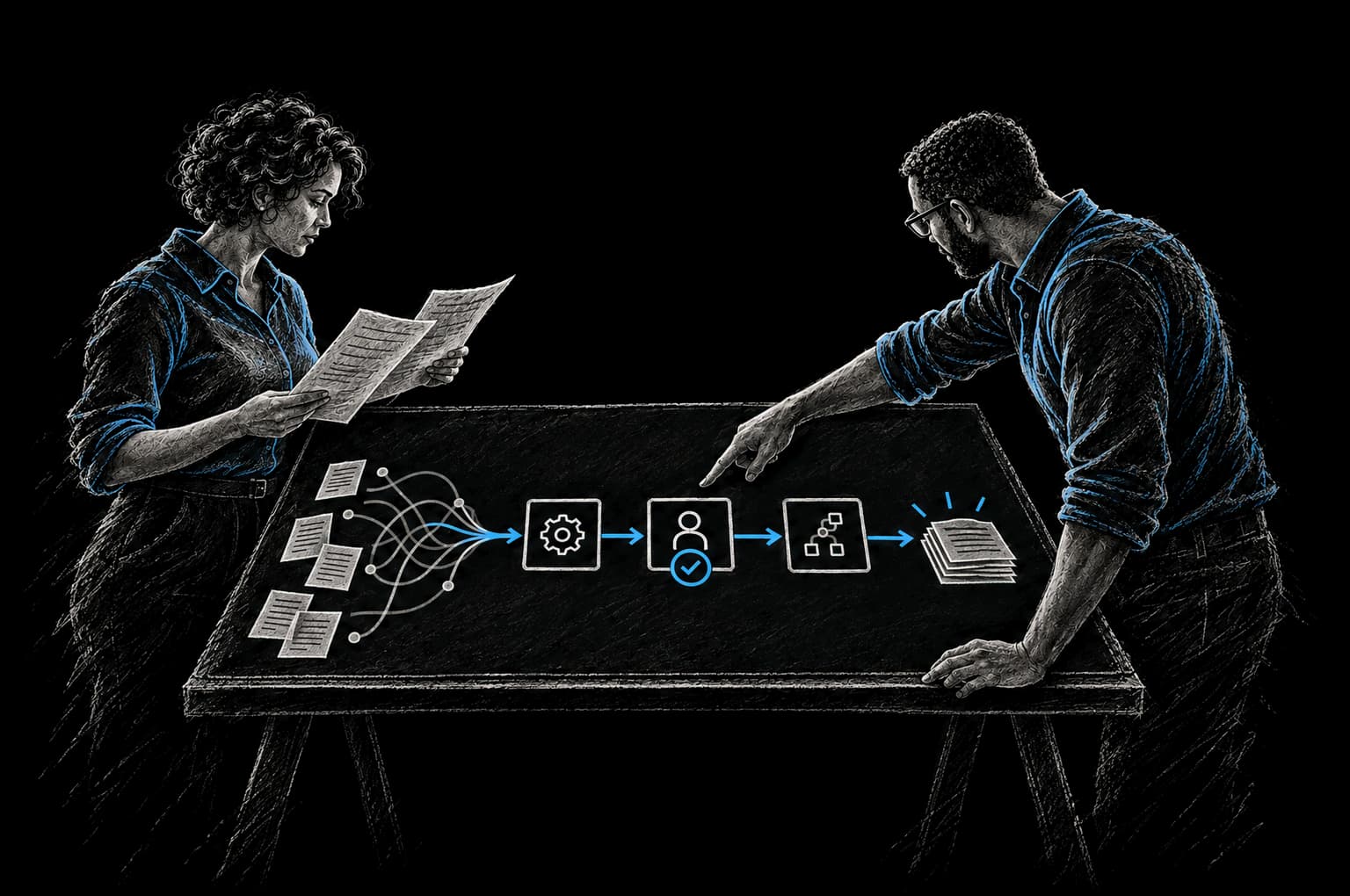
Operating Friction
Signs you're operating blind
- Status lives in inboxes and people's heads
- Reports are stale the moment they're finished
- Problems surface after they cost money
You run a business. But do you actually know what's happening in it right now?
Most business leaders can't answer basic operational questions without asking around or pulling together a manual report:
Where does this job stand? How much of it is complete and when will it finish?
Which customers are at risk? Whose renewals are coming up, and which ones look uncertain?
Which invoices are overdue? Who hasn't paid, and who is just slow?
What's the team working on right now? Are we on track to hit this month's goals?
These are operational questions, and they should have real-time answers. Instead, the answer requires pulling data from multiple systems, spreadsheets, and email threads. Or you ask someone. And that person might have last week's information.
The cost isn't just time spent in meetings asking for status updates. It's the decisions made on stale information, the problems discovered after they've already had impact, and the competitive advantage given away to companies that see their business in real time.
This is a workflow visibility problem.
Why You Can't See What's Happening
Most organizations have visibility gaps because they grew without operational system design.
Status lives in individuals' heads. One person knows where a job stands because they're working on it. Another person knows the customer is unhappy because they had a call last week. But there's no shared system that captures this information. The moment they leave, the information goes with them.
Status is trapped in email threads. Someone sends updates in an email chain to a small group. The status exists, but it's scattered across inboxes and difficult to aggregate into a picture of what's actually happening. It's not queryable, not searchable in any systematic way, and it changes every time someone replies.
Data is locked in different systems. The project management tool has task status. The CRM has customer status. The accounting system has invoice status. Shipping software has order status. No single system talks to the others. Getting a complete operational picture requires manual aggregation.
Reports require manual compilation. Management visibility requires someone to sit down every week or every day, log into multiple systems, pull the same data, and put it into a spreadsheet. The report is stale the moment it's finished. It's also dependent on whoever is responsible for compiling it.
Problems are discovered reactively. You don't learn about an overdue invoice until the customer complains. You don't learn about a delayed project until the stakeholder asks. You don't learn about a pipeline risk until it's already late. Real-time visibility means discovering issues when they start to form, not after they've already had business impact.
Different teams work from different information. Sales thinks we're on track. Operations knows we're behind. Finance sees a problem that nobody else has flagged. Everyone has partial information, and that partial information is sometimes contradictory.
The cost of this fragmentation is real. Manual re-entry and reconciliation across disconnected systems is a recurring cost most mid-market companies have never measured. Our assessment measures it. And McKinsey found (opens in a new tab) data-driven organizations are 23 times more likely to acquire customers, six times as likely to retain them, and 19 times as likely to be profitable.
The gap isn't information. It's visibility.
What Workflow Visibility Actually Looks Like
When visibility works, the operational questions that now require a manual report are answered instantly.
Real-time dashboards. A dashboard shows the current state of whatever is operationally critical: pipeline, projects, customer health, inventory, production status, anything. The dashboard updates automatically as data changes. A manager doesn't have to ask for status. They see it.
Automatic escalation. The system knows when something goes off-track and alerts the right person automatically. An invoice is overdue. A project is behind schedule. A customer has opened five support tickets in the last week. The system surfaces the issue so it gets attention immediately, not after it's already cost money.
Unified data. Instead of pulling information from multiple systems, there's a single operational source of truth. A customer record in the CRM connects to their invoice status in accounting, their order history in shipping, and their support history in the ticketing system. One view gives complete context.
Transparent workflows. When someone updates a status, the update is immediately visible to everyone who needs to know. A job moves from "in progress" to "review." A customer's renewal status changes to "at risk." A shipment is marked as delivered. That information is live for anyone who needs it.
No manual reporting. Dashboards and reports query the live system in real time. Nobody has to spend Friday afternoon pulling data from five different places and consolidating it into a PowerPoint. That work is automated.
Historical context. The system keeps a record of changes over time. You can see not just the current status, but how things changed. That visibility helps identify patterns, predict problems, and spot when something is trending in the wrong direction.
The result is that leaders and teams operate from the same information, see problems early, and make decisions based on data instead of last week's email.
How Visibility Changes Operations
When workflow visibility improves, operational efficiency often improves with it.
Teams move faster because they're not blocked waiting for status updates. A person finishing one task doesn't have to email the next person. The system routes the work automatically. The next person sees it immediately. There's no friction.
Problems get solved before they cascade. An invoice is overdue, the system flags it, and it gets attention today instead of after a dispute. A project is slipping, the team adjusts before it becomes late. A customer is unhappy, support escalates before they cancel.
Talent gets used better. People spend less time in status-update meetings and more time doing actual work. The information exists in the system, not in people's heads.
Scaling becomes possible. When status is captured in a system instead of individuals' heads, you can add people and processes without creating new bottlenecks. The visibility scales with the company.
The InTech Approach to Workflow Visibility
At InTech Ideas, we build operational visibility systems as part of our product engineering approach. It usually starts with understanding what's actually happening right now: Where is information living? How is status being communicated? What questions do leaders need answered every day?
Most businesses need three things for real visibility:
First, a system of record. Data has one place it lives. A customer is a customer record, not a name scattered across email and spreadsheets. An order is an order, not a status that exists in three different systems. A project is a project with a unified view of progress, risks, and schedule.
Second, connected workflows. When something happens in one part of the system, it flows to the next part automatically. Accounting receives an invoice because a contract was signed, not because someone manually entered it. A customer's status updates in the CRM because they made a payment, automatically. Workflows move work forward without manual handoffs.
Third, visibility tools. Dashboards, alerts, and reports that surface the information leaders and teams need to operate. These are built specifically for your business, not a generic dashboard that works for nobody.
We usually implement this incrementally. First, we might build a dashboard that consolidates data from your existing systems. Then we replace a manual process with a workflow. Then we add another dashboard, another automation. The visibility increases month by month, and the business sees improvement early.
A Build Pod is common for companies building workflow visibility systems. The Build Pod is ongoing delivery capacity with a Product Delivery Lead, staffed to the shape of the work and managed against outcomes. Commercial terms are agreed per engagement. We work alongside your team to understand operations, design systems, and gradually replace manual processes with automated ones.
Frequently Asked Questions
How long does it take to get meaningful visibility?
Some visibility can be built in weeks. A dashboard that pulls data from your existing systems and shows status in real time is often a quick win. Deeper integration takes longer. We scope projects so you see value early and iterate from there.
Do we need to replace all our existing software?
No. We work with the software you already have. Most modern systems have APIs. We integrate them so data flows automatically. You keep what works and add visibility on top.
What if our data is messy?
Most operational data is messy. It's why visibility is hard. We help clean it during implementation. But more importantly, once data flows through a structured system, it gets cleaner automatically. The system enforces consistency going forward.
Who sees what? Is this a privacy problem?
You control it completely. A dashboard for the sales team shows sales information. A dashboard for operations shows what operations needs. A customer support rep sees their own tickets, not financial data. Access is designed for your specific business.
How do you know the data is accurate?
The system enforces accuracy by preventing bad data from entering. Forms validate that a date is a date, that a number is a number. Workflows require data in the right format. Over time, this creates more reliable information than manual processes ever could.
Can you integrate with our existing accounting software?
Almost certainly yes. We work with QuickBooks, NetSuite, Xero, Stripe, and most modern platforms. If there's an API, we can connect it.
From Friction to Proof
Bring us the part that’s getting in the way.
Tell our AI agent what you want to improve. We’ll help you find a useful first step.
Start with our AI agent. Find your next step.