Problems We Solve
Reducing Operational Bottlenecks: Where AI and Automation Create Flow
Bottlenecks hide in approvals, handoffs, and knowledge that only one person holds.
Start with our AI agent. Find your next step.
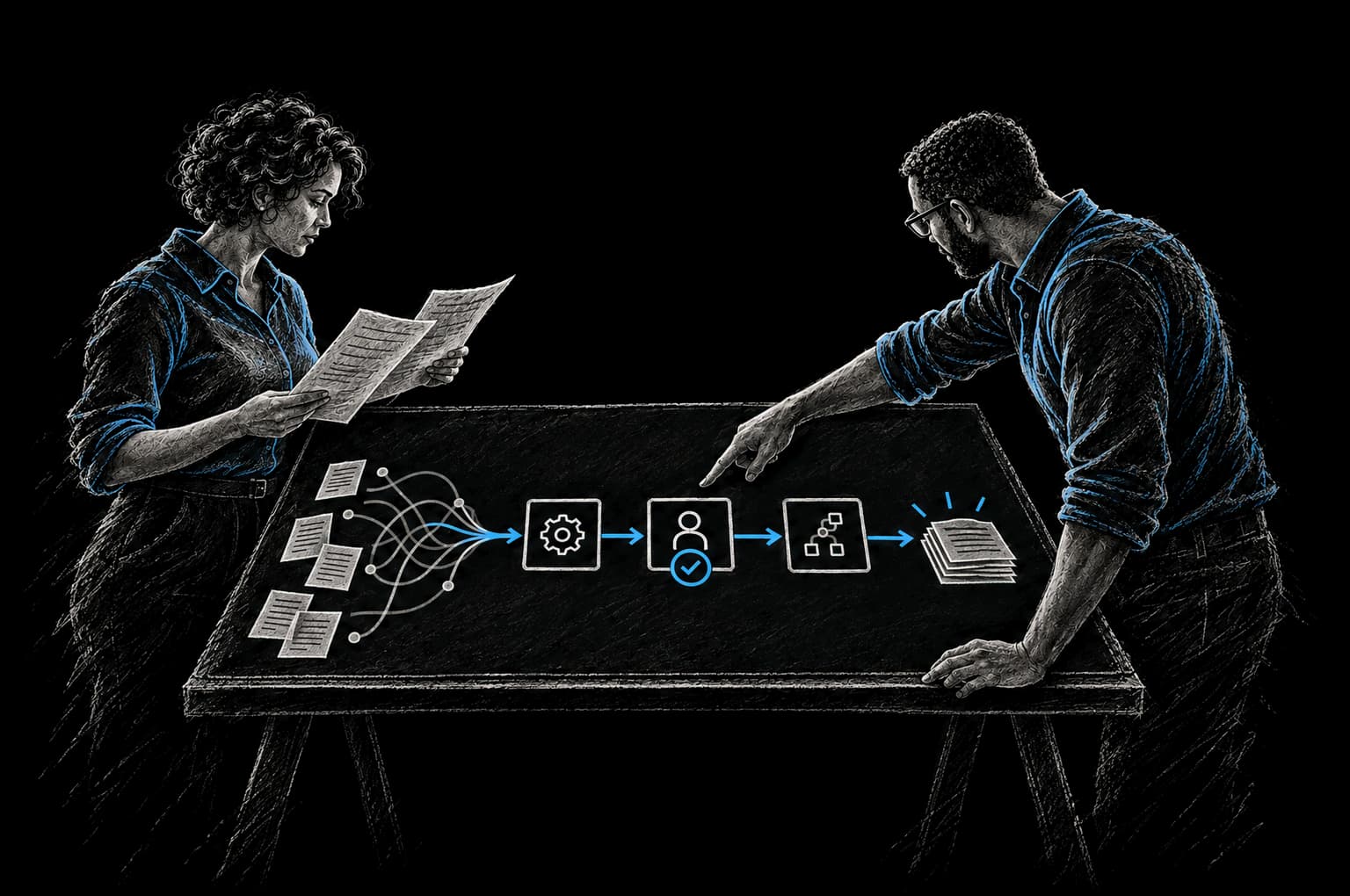
Operating Friction
Where work queues up
- Work waits days for a quick approval
- Only one person can handle the exceptions
- Orders sit until the next batch run
Every business has them. Places where work queues up. Where customers wait. Where your team spends energy coordinating instead of delivering.
A customer fills out a form. Three days later it still hasn't been reviewed. Someone is waiting for data from another system. That data exists somewhere, but nobody automated the handoff. A project can't move forward because it needs approval from someone who's in back-to-back meetings. An exception comes through that only one person knows how to handle.
These are operational bottlenecks. They're not usually broken. They're just not flowing.
Most businesses can identify their big bottlenecks if they look. Few actually fix them. So they stay. Work queues up. Customers wait. Your team gets frustrated that they're handling busywork instead of doing their real jobs. And every quarter you wonder why you're not shipping as much as you should be.
The good news: bottlenecks are visible and fixable. The sequence is predictable. You identify where queues form, automate or streamline the constraint, and flow increases. It's not complicated. It just requires seeing where the friction actually is.
The Bottleneck Problem: Why Flow Matters
Flow is what operations are supposed to do: move work from start to finish as fast as possible without getting stuck.
Bottlenecks are the opposite. They're places where work stops, waits, or slows to an unnatural pace. From the customer's perspective, flow breaks. From your team's perspective, they're waiting on something they can't control.
This costs money in three ways:
Waiting creates cost. If your customer waits 5 days for approval, that's 5 days of delayed value delivery. If they're on a trial, they might give up. If they're a paid customer, you're delaying their success.
Coordination overhead drains your team. Someone has to follow up. Check on status. Nudge the approver. Find out why the data hasn't been moved. This coordination work adds nothing to the outcome. It's pure friction.
Exceptions require heroic effort. If only one person knows how to handle a certain type of order, that person becomes the bottleneck. They're pulled into meetings. They're the escalation path when something goes wrong. They burn out. And when they leave, your operations are paralyzed.
IBM research (opens in a new tab) on data quality found that poor data quality costs U.S. businesses approximately $3.1 trillion annually. Some of that cost shows up as bottlenecks: data that doesn't move smoothly between systems. Information gets stuck. Someone has to manually move it. Process slows. Cost compounds.
Nearly 60% of workers estimate they could save 6 or more hours per week if repetitive tasks were automated (Smartsheet (opens in a new tab)). But bottlenecks aren't always about repetition. They're often about coordination, approval, or data access. Fix those, and your team's productive hours increase.
Four Types of Bottlenecks
Not all bottlenecks look the same. Identifying the type matters because the fix is different for each.
Type 1: Approval Bottlenecks
Work is ready to move forward, but it needs approval. The approver is busy. The approval decision takes days. The work waits.
This is the most common type of bottleneck. A customer needs a discount. It has to be approved. The approval process exists to prevent bad decisions. But if it takes three days to get approval for something that's decided in 30 seconds, the system isn't protecting anything. It's just slow.
The fix: Automate the approvals that don't require judgment. If a customer requesting a 5% discount doesn't need human judgment (the policy is clear), automate it. For approvals that do require judgment, create dashboards that surface pending approvals with context so the approver can act immediately instead of hunting for status.
Type 2: Data Handoff Bottlenecks
Information needs to move from one system to another. This happens manually. Someone exports from System A, imports to System B, fixes the format issues, validates the data. This work happens once per day, or once per week, depending on process.
Your customer's order is placed in one system. It needs to move to your accounting system, then to fulfillment, then to shipping. If each handoff is manual, each one is a place where the order can get stuck.
The fix: Integrate your systems so data flows automatically. When an order is placed, it flows into accounting and fulfillment without manual intervention. When inventory is updated, that flows into your order system automatically. Handoffs disappear. Bottlenecks go with them.
Type 3: Coordination Bottlenecks
The next step can't start until someone communicates that the previous step is done. This information exchange is manual and async.
"When will the design be ready? I need it before I can start engineering." "When's engineering done? We need to test." "When will testing be complete? We need to ship." These are all legitimate questions. But if they require email threads and status meetings, they're coordination bottlenecks.
The fix: Build dashboards and automations that communicate status automatically. When design is done, engineering sees it immediately and knows they can start. When testing begins, the team who needs to ship gets notified automatically. Information flows. People don't have to ask.
Type 4: Knowledge Bottlenecks
A certain type of decision, exception, or complex workflow only one person understands. That person is the bottleneck. When they're busy or unavailable, the work stalls.
"Only Jane knows how to handle international orders." "Only Mike understands our weird fulfillment rules." These create dependencies that kill flow. And when Jane or Mike leave, the system breaks.
The fix: Make the knowledge explicit. Document the decision trees. Build systems that encode the rules. Create guides for handling exceptions. The goal is that anyone on the team can handle the decision, not just the expert.
How to Identify Your Biggest Bottlenecks
Most organizations don't have trouble identifying bottlenecks. They know where work slows. They've been frustrated by it for months. The trouble is that bottlenecks feel normal. "That's just how it works." So they stay.
Here's how to be systematic about it:
Map your core workflows. Pick the work that matters most: customer onboarding, order processing, approvals, hiring, client delivery. Map the steps. From start to finish, what has to happen? Write it down.
Measure time at each step. How long does each step take? Be specific. Not "onboarding takes a couple weeks." "Initial assessment takes 2 days, account creation takes 4 days, setup call takes 1 day, documentation takes 5 days."
Identify where work waits. Which steps have queues? Where is work waiting on something? Count the hours of wait time in your critical path. That's bottleneck time.
Calculate the cost. If your customer waits 5 days in a process that could take 2 days, that's 3 days of waiting that costs you and them. If 20% of your customers wait that long, and your average customer is worth $X per day in value, you're leaving Y dollars on the table.
Rank by impact. Which bottleneck would create the most improvement if fixed? Start there.
The Bottleneck-Fixing Sequence
Once you've identified your biggest bottleneck, the fix follows a pattern:
Step 1: Understand why the bottleneck exists. Is it a decision that takes time? An approval process? A system that doesn't communicate? Data that needs to be manually moved? Data quality issues that create rework? Understanding the root cause directs the fix.
Step 2: Decide if you should automate, streamline, or restructure. Some bottlenecks are best fixed by automation (remove manual steps). Some by streamlining (make the existing process faster). Some by restructuring (rethink whether the constraint should exist at all).
For example, if approvals are your bottleneck because the approver is overloaded, automation might be the fix (approve things that don't need judgment). Streamlining might be the fix (give the approver better tools to review faster). Or restructuring might be the fix (push approval authority further down, only escalate exceptions).
Step 3: Make the change, measure the impact. If you automate an approval, measure: How many approvals now happen without human review? How much faster? If you integrate systems, measure: How many manual handoffs disappeared? How much faster is the overall flow?
Step 4: Identify the next bottleneck. Fix one bottleneck and work flows to the next constraint. That next constraint is now your bottleneck. Repeat.
This is how flow improves. Not in one big project. But through systematic identification and removal of constraints.
Illustrative Examples: Bottleneck Fixes
Hypothetical scenarios to show the pattern; figures are illustrative, not client results.
Example 1: Customer Onboarding Bottleneck The workflow: Customer signs up. Sales team is notified. Sales sends customer to onboarding team. Onboarding creates an account, sends credentials, schedules setup call. Setup call happens. Onboarding sends documentation. Customer can start using the product.
The bottleneck: Each handoff waits on an email and someone taking action. Average time: 10 days. Customers often churn before completing onboarding.
The fix: Automate the account creation and credentials. The moment a customer signs up, the system creates their account, sends credentials, and emails the support team with context. Support immediately schedules the setup call. Documentation is sent automatically after the call. Average time: 24 hours.
Impact: Customers onboard in about a day instead of ten, so fewer drop off before they start. Onboarding team spends less time on routine handoffs and more on helping customers with actual needs.
Example 2: Order Processing Bottleneck The workflow: Customer places order. Order needs to be reviewed (fraud check, inventory verification). If it passes, it goes to fulfillment. Fulfillment prepares and ships. Customer gets tracking info.
The bottleneck: Review happens once per day in batch. Orders placed at 5 PM wait until the next morning for review. While they wait, inventory might sell out. Or fraud check might fail but someone doesn't notice for a day.
The fix: Automate the review. System checks fraud score in real time. System checks inventory in real time. If both pass, order moves to fulfillment immediately. If something is flagged, order goes to a queue for manual review, but that review happens immediately, not the next day.
Impact: Most orders are processed within hours of placement instead of the next day. Inventory matches reality (no overselling). Customers see shipping confirmations same-day instead of waiting.
Example 3: Approval Bottleneck The workflow: Employee needs approval for an expense, a discount, a hiring decision, a project timeline. Approval goes to a manager. Manager is in meetings. Email gets buried. Approval takes 5 days. Employee waits. Project waits.
The bottleneck: Approvals are async and buried in email. No visibility into what's pending. No escalation if approval takes too long.
The fix: Approvals move to a dashboard. Approver sees all pending approvals with context. System shows how long each has been waiting. Approver can act from phone or browser. System escalates if approval takes more than 24 hours. Stakeholders are notified when status changes.
Impact: Average approval time drops from 5 days to 8 hours. Approver is more consistent (everything goes through the same dashboard, not scattered in email). Escalations are clear (not ambiguous).
How InTech Ideas Reduces Your Bottlenecks
We don't assume we know where your constraints are. We measure them.
Using our CRAFT methodology, we map your critical workflows end-to-end. We measure how long each step takes and where work waits. We calculate the cost of waiting. We rank bottlenecks by impact.
Then we fix them in sequence, always measuring impact:
In an Express Pod, we focus on one critical bottleneck. Identify it. Fix it. Measure the improvement. An Express Pod puts one measurable improvement into production in weeks, with the timeline agreed in the Intent Contract before build starts.
In a Build Pod, we systematically work through your top 3 to 5 bottlenecks. The Build Pod is ongoing delivery capacity with a Product Delivery Lead, staffed to the shape of the work and managed against outcomes. Commercial terms are agreed per engagement. We integrate systems where handoffs are happening. We automate approvals that don't require judgment. We build dashboards that surface flow in real time.
For teams running a Build Pod configured for multiple workstreams, we redesign your operations around flow. Every workflow is optimized. Systems communicate automatically. Bottlenecks are identified and addressed continuously.
The output is the same across all engagements: visible improvement in how fast work moves. Customers wait less. Your team is less frustrated. And you're shipping more because less energy is spent on coordination and busywork.
Common Mistakes in Bottleneck Reduction
Mistake 1: Fixing a bottleneck that doesn't exist Don't guess. Measure. Which workflow is actually slowing you down? How much time is actually being lost? Not all bottlenecks matter equally. Fix the ones that create the most impact first.
Mistake 2: Automating a bottleneck instead of fixing its root cause If approval is slow because the approver is overloaded, automating the approval process helps. But if the real problem is that too many decisions require approval, you've built a faster broken system. Understand the root cause first.
Mistake 3: Fixing flow in one area and ignoring the next constraint Fixing one bottleneck is progress, but work will now queue at the next constraint. You have to identify and fix that next one, or flow stops again. This is continuous improvement, not a one-time project.
Mistake 4: Not measuring before and after If you don't know how slow the process was before, you won't know if the fix actually worked. Measure baseline. Make the change. Measure after. If you can't prove improvement, you didn't fix the bottleneck.
Mistake 5: Not involving the team doing the work Your team knows where the friction is. They know what's actually slowing them down vs. what the org chart says should be slow. Include them in identifying bottlenecks and designing fixes. Their input is essential.
FAQ: Reducing Bottlenecks
How do we prioritize which bottleneck to fix first?
Rank by business impact. Which bottleneck costs you the most in lost revenue, delayed delivery, or unhappy customers? Which one, if fixed, would create the most operational improvement? Start there.
How long does it take to fix a bottleneck?
It depends on the type. Approval bottlenecks (with dashboards and automation) are usually the quickest to fix. Data handoff bottlenecks (integrating systems) and knowledge bottlenecks (making expertise explicit) take longer. Most single-bottleneck fixes land in weeks, with the timeline agreed in the Intent Contract before build starts. Measure before you start so you know what success looks like.
Do we need to stop everything to fix a bottleneck?
No. Most bottleneck fixes can happen in parallel with regular operations. You're not changing the workflow while work is moving through it. You're building the improved workflow, then switching to it.
What if we fix the bottleneck and work still backs up?
That means you've hit the next constraint. Work now queues at the next bottleneck. That's progress. Identify and fix the next one. This is how flow improves.
How do we know if the bottleneck is fixed?
Measure the metric you identified at the start. If approval used to take 5 days and now takes 8 hours, approval is fixed. If order processing used to take 18 hours and now takes 3 hours, it's fixed. Don't guess. Measure.
Should we fix all bottlenecks at once?
No. Fix them in sequence of impact. Fixing the biggest bottleneck usually creates the most improvement with the least effort. As flow improves, the next constraint becomes visible.
From Friction to Proof
Bring us the part that’s getting in the way.
Tell our AI agent what you want to improve. We’ll help you find a useful first step.
Start with our AI agent. Find your next step.