Problems We Solve
Legacy Process Modernization: Updating How Your Business Operates
Legacy processes still work. They just can't keep up with the business you run now.
Start with our AI agent. Find your next step.
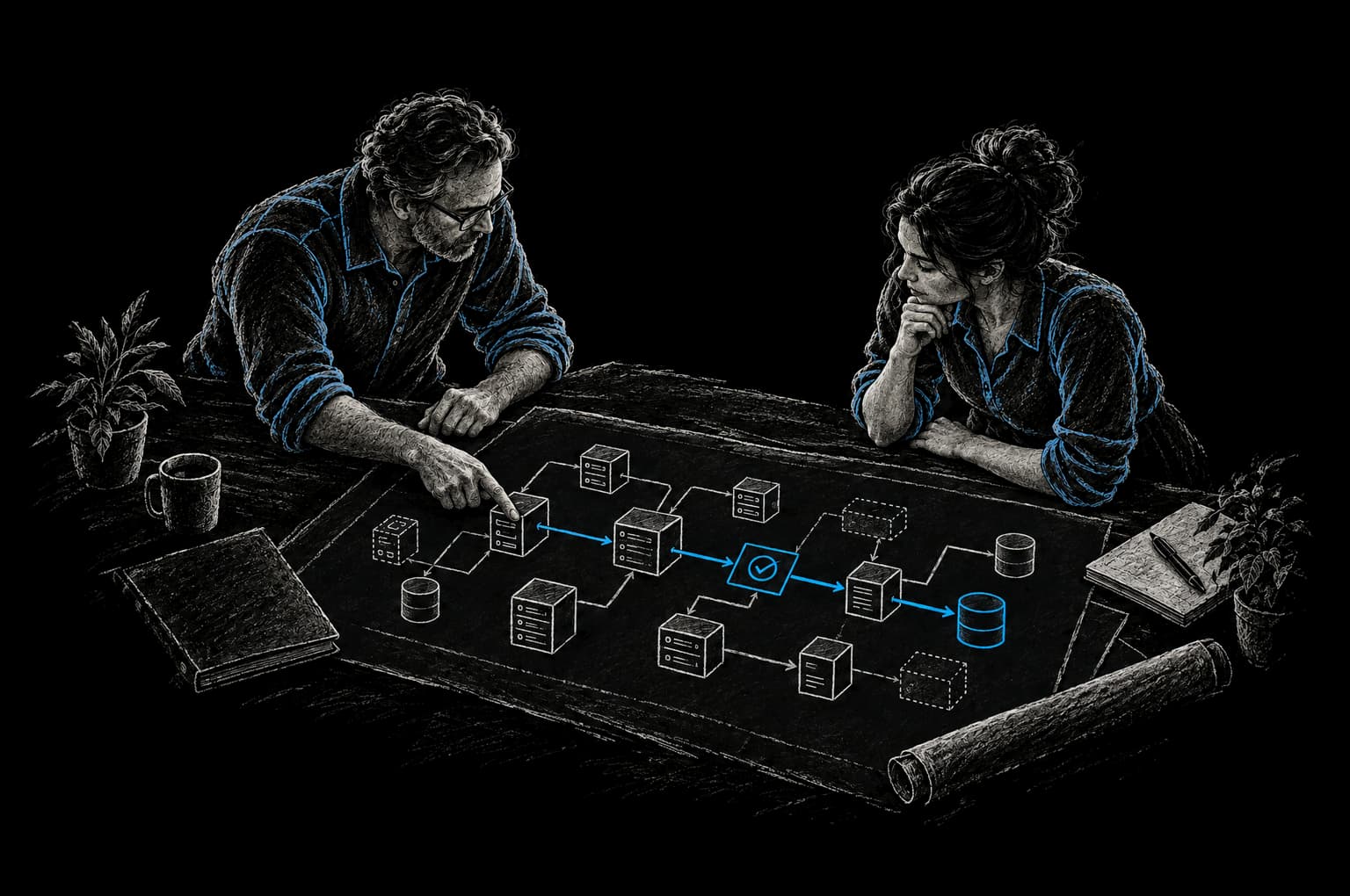
Operating Friction
Built for a smaller business
- A spreadsheet workaround that became permanent
- One person holds the process in their head
- Fifteen steps where five need a human
"Legacy" usually means old software. But it doesn't always.
Legacy can mean any process that was designed for a previous version of your business. A process built when you were ten people. A process optimized for a single product. A process designed for a customer base that has since tripled. A process that made sense three years ago but now constrains everything you're trying to do.
Most growing companies have legacy processes. They're not always obvious because the processes usually work. They move work forward, transactions get completed, money changes hands. But they're slower than they should be, they require manual steps that could be automated, they depend on specific individuals who carry the knowledge, and they constrain what's possible at the next scale.
The company can't move as fast as the market demands because the operations can't move that fast. The result is that growth becomes bottlenecked by how the business operates, not by what it can sell.
This is a legacy modernization problem.
Why Legacy Processes Exist
Most legacy processes aren't the result of bad decisions. They're the result of good decisions made under different constraints.
Processes built for a smaller company. When you had five people, a process where one person kept inventory in their head worked fine. They knew what was in stock. Now you have fifty people and three locations. That same inventory process fails. It was never designed for that scale.
Workarounds that became permanent. Five years ago, the old system broke. You temporarily switched to a spreadsheet. That spreadsheet was supposed to be temporary. It's still running the business five years later, held together with formulas and prayers, because nobody has prioritized replacing it.
Manual steps that nobody has prioritized. A form gets filled out, then someone manually types the data into the accounting system. A report gets compiled, then someone manually pastes it into a presentation. These steps could be automated. But each one is small enough that it's never felt urgent enough to fix.
Technology decisions from years ago. You bought an off-the-shelf system that worked fine for your business as it was. Now you've evolved beyond what that system was designed for. The system has become a constraint.
Processes that depend on people. One person knows how the accounting process works. One person runs the monthly billing. One person manages customer onboarding. If they leave, the company loses the operational knowledge and has to rebuild it from scratch. This creates risk and slows scaling.
A backlog of small friction points. The process has a fifteen-step workflow where maybe five of those steps actually need human input. The other ten could be automated. But fixing one step at a time feels slow, so nothing gets fixed.
The result is that the company operates slower than it needs to, spends more time on operational tasks than strategic ones, and can't move at the speed the business requires.
The Cost of Outdated Operations
Legacy processes cost more than just efficiency.
Slower response to market changes. If your customer onboarding process takes three weeks, you can't respond to a customer who needs to onboard in one week. If your billing process is manual, you can't launch a new pricing model without massive manual work. If your reporting is fragile, you can't easily add new metrics. The process becomes a constraint on business strategy.
Higher risk of error. Manual processes are fragile. A data entry error compounds through systems. A person skips a step. A spreadsheet formula breaks. The more manual a process is, the more opportunities there are for something to go wrong. And when something does go wrong, it takes time to find and fix.
Lost operational knowledge. When processes depend on people instead of systems, leaving the company is a crisis. It's also an incentive to not improve the process because the current person knows it and changing it is risky.
Inability to scale. You can hire people. You can't scale processes that depend on individuals knowing how things work. At some point, growth hits the ceiling of how many people need to be involved in operations versus doing the actual work the business was hired for.
Competitive disadvantage. If your competitor can onboard customers in one week and you take three, they win. If they can launch a new product in one sprint and you need three, they win. Fast operations are a competitive advantage. Slow, legacy operations are a competitive disadvantage.
McKinsey's 2025 State of AI (opens in a new tab) report notes that only 21% of organizations using gen AI have redesigned their workflows around it. Modernization is the gap. The companies that redesign operations early gain competitive advantage. The companies that run legacy processes fall behind.
What Modernization Looks Like
Modernization doesn't always mean ripping out the old system and replacing it with something new. It usually means upgrading incrementally.
Automate one step at a time. A process has ten steps. Step three could be automated. Automate it. The process runs faster and requires less manual work. Then look at step five. Automate that. After a few months, half the process is automated and the whole thing is faster.
Replace manual handoffs with workflow tools. In a legacy process, one person finishes work and emails it to the next person. That person manually enters it into their system. A workflow tool routes the work automatically and tracks it. Everyone knows what's next and who's responsible.
Connect systems that were built independently. Accounting software talks to project management software. The CRM feeds customer data to support ticketing. Invoices automatically generate from signed contracts. Information doesn't have to be manually copied between systems.
Build dashboards where manual reporting existed. A manager used to spend Friday compiling a report from five different sources. Now a dashboard shows the same information in real time. The report happens automatically.
Move operational knowledge from people into systems. The current person knows how the billing process works. Document it. Build it into the system. Now the next person can follow it without months of tribal knowledge transfer.
Gradually sunset the old process. The legacy spreadsheet that's been running for five years doesn't go away overnight. But you build a new system alongside it, migrate data gradually, and phase out the old system once the new one is proven.
The result is that operations move faster, require less manual work, are less dependent on specific people, and can scale without hiring someone to manage operations.
The InTech Approach to Modernization
At InTech Ideas, modernization usually starts with understanding what's actually happening now and where the friction is.
We talk to the people who do the work. We see the process in action. We understand what's manual, what's fragile, where errors happen, and where the bottlenecks are. Most of the time, the process is solving a real problem well. The issue is the tools or the structure.
Then we prioritize. Not every inefficiency needs to be fixed. We focus on:
Steps that are done frequently (fixing a daily step has more impact than fixing a monthly step)
Steps that are error-prone (reducing risk)
Steps that block other work (removing bottlenecks)
Steps that depend on specific people (eliminating single points of failure)
We often start with an Express Pod to prove the value on one process before tackling the broader modernization. An Express Pod puts one measurable improvement into production in weeks, with the timeline agreed in the Intent Contract before build starts. Broader modernization usually runs as a Build Pod. The Build Pod is ongoing delivery capacity with a Product Delivery Lead, staffed to the shape of the work and managed against outcomes. Commercial terms are agreed per engagement.
We build incrementally so you see value immediately. First, we might build a web form that replaces a manual data entry process. That runs parallel to the old system until everyone trusts it. Then we automate the next step. Over time, the legacy system becomes less critical.
The goal isn't to rebuild everything at once. It's to systematically upgrade how the business operates so it can grow without hitting operational ceilings.
Frequently Asked Questions
How long does modernization take?
It depends on the scope. A single process can often be modernized in weeks. A larger operational redesign takes longer. We scope each engagement clearly and deliver value incrementally so you don't have to wait months for results.
Do we have to stop using the old system while you build the new one?
No. We build the new system alongside the old one. Both run in parallel until the new system is proven and stable. Then we migrate data and retire the old system. This reduces risk and lets you keep operations running.
What if the team is resistant to change?
Change is often hardest when people don't see the value. That's why we focus on fixing real friction points. When someone spends five hours less per week on a manual process, they usually embrace the change pretty quickly. We also make sure the new system is easier to use than the old one.
What if we need customization that off-the-shelf software can't do?
That's exactly when custom software is the right approach. Off-the-shelf tools are optimized for generic companies. Your business is unique. Custom systems are designed specifically for how you operate.
Can we modernize one department while leaving others alone?
Yes. You can modernize accounting processes while leaving sales as-is, or vice versa. However, companies often find that once one department modernizes, others want it too. The value becomes obvious.
How much does this usually cost?
Cost depends on the number of systems and the complexity of the workflow. We scope it after an assessment and give you a clear price before work starts. We build the business case with you from your own baseline, so you can see the expected payback before you commit. The Intent Contract sets the baseline and the date we verify against.
What if we're already using software for this process?
We often integrate or build on top of existing software rather than replace it. If the software has limitations, we build additional tools around it. If the software is the constraint, we'll recommend replacement. Either way, we're specific about the decision.
From Friction to Proof
Bring us the part that’s getting in the way.
Tell our AI agent what you want to improve. We’ll help you find a useful first step.
Start with our AI agent. Find your next step.