Problems We Solve
Improving Team Productivity with Better Systems and Automation
Most lost time comes from systems that make people carry information by hand.
Start with our AI agent. Find your next step.
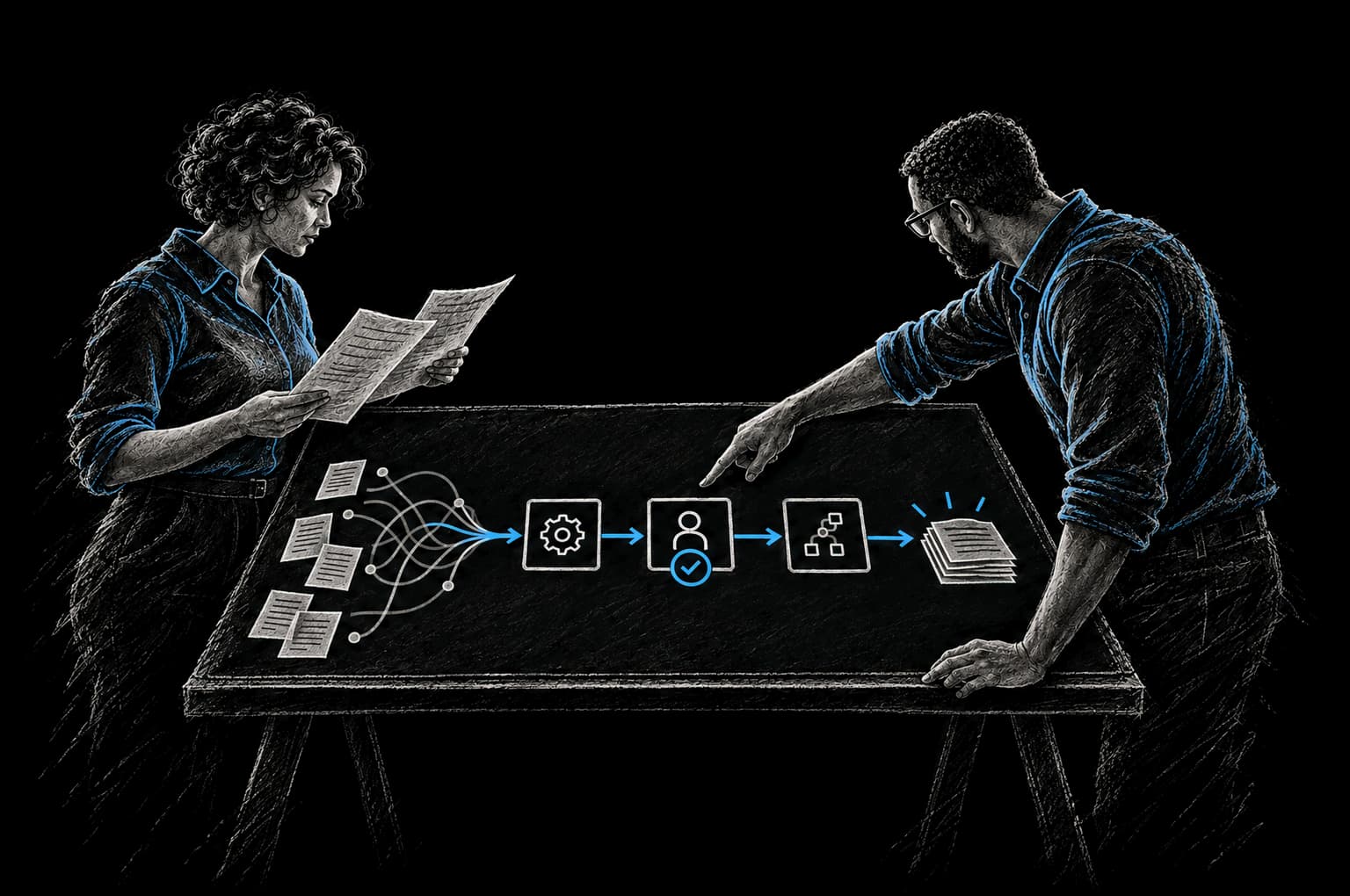
Operating Friction
Where productivity leaks
- Hours lost to re-entering the same data
- Standups that exist only to share status
- Your best people field the most questions
Your team isn't lazy. They're drowning in busywork.
Every day, your people spend hours on things that don't move the needle. Manual data entry. Context-switching between disconnected tools. Hunting for information that should be at their fingertips. Sitting in meetings to answer questions a dashboard could answer in seconds.
The problem isn't effort or talent. It's friction. It's systems that force your team to do work the hard way.
When you remove that friction, productivity doesn't just improve. It explodes.
The Real Productivity Killers
Most productivity frameworks focus on willpower and time management. That's backward. You can't discipline your way out of a bad system.
Here are the actual culprits:
Time spent on manual data entry and reconciliation
Your team manually enters the same data into multiple systems. A customer signs up on your website. Someone enters them into the CRM by hand. Someone else re-enters them into billing. Someone copies their contact info into Slack for the operations team. Three entries of the same data. Three chances to get it wrong. Twenty minutes of combined time on something that should take five seconds.
Multiply this across your organization. That's dozens of hours every week gone to data entry.
Context-switching between disconnected tools
Your team uses Slack, email, Asana, Salesforce, Stripe, and your custom database. To answer a single customer question, they have to jump between four tools. Each context-switch costs focus time and introduces the risk of looking at stale information.
The cognitive load is real. Research on workplace interruptions suggests it can take more than 20 minutes to get back to a task after an interruption. Your team isn't interrupted by people. They're interrupted by their own software stack.
Waiting for information from other systems or people
A customer support agent needs to know the customer's billing status. They email the finance team. An hour later, they get a response. In the meantime, the customer is still waiting.
This pattern repeats across every function. Sales waiting on implementation status. Operations waiting on vendor information. Customer success waiting on billing details. All of it preventable.
Meetings to answer questions that a dashboard could answer
You scheduled a standup to get visibility into project status. Twenty people on the call. Fifteen minutes of people reading updates that could have been a shared document. That's 300 minutes (five hours) of collective time to answer a question that real-time dashboards could answer instantly.
Repetitive work that never gets automated because "it only takes a minute"
A task that takes a minute to do manually, repeated 50 times a week, is 50 minutes. Repeated across your team, it's hours. But because each instance feels small, nobody bothers to automate it.
Those small moments add up to the productivity crisis most organizations live with.
Why This Matters
A team that spends 10 hours a week on friction is a team that only has 30 hours a week for work that creates value.
Worse, the friction isn't evenly distributed. Your best people tend to end up carrying the most context and answering the most questions. So the friction tax falls heaviest on your most productive people.
The Solution: Connected Systems and Targeted Automation
Productivity comes from removing friction, not managing it better.
The solution is to architect your systems so information flows automatically where it needs to go, workflows enforce themselves, and your team works with real-time data instead of hunting for it.
This isn't about replacing your team with robots. It's about eliminating the dumb work so they can focus on judgment calls, relationships, and strategy.
Remove manual data entry with integration
When a customer is created in Stripe, they automatically appear in your CRM. When a deal closes in your CRM, it automatically creates a project in your project management tool. When an invoice is marked paid in Stripe, it automatically updates your accounting system. One entry. Automatic propagation. One source of truth.
Enforce workflows with automation
Instead of sending a Slack reminder asking someone to remember the next step, a workflow automation does it. When a support ticket comes in with certain keywords, it automatically creates a task. When a task is completed, it automatically notifies the next person who needs to act. Humans don't have to remember the steps. The system enforces them.
Give your team real-time visibility
Instead of a weekly standup, everyone has access to a dashboard that shows current status. Who's blocked. What's in progress. What's waiting. Status updates pull data directly from your systems, so they're always current. Your team spends minutes a week on status management instead of hours.
Stop context-switching with unified information
When your team member needs information about a customer, they go to one place and find everything: billing history, support tickets, implementation notes, contract details. Not scattered across Slack, email, Salesforce, and some shared drive. This alone removes the need for many status meetings.
Illustrative Examples
Hypothetical scenarios to show the pattern; figures are illustrative, not client results.
Example 1: Onboarding automation
Before: Customer signs up. Email to the ops team. Manual check if they have all required info. Back-and-forth via email. Sales rep manually enters customer into CRM and project tool. Implementation team goes hunting for customer details and project scope.
After: Customer signs up. Automated workflow captures their data in your CRM. A dashboard appears for the sales rep showing everything auto-populated. Implementation team receives a notification with a complete context packet (customer info, contract, scope, any special requirements) automatically pulled from your systems. Sales rep has zero manual work. Implementation team has zero hunting-for-info work.
Result: Customer onboarded 3 days faster. Sales rep saves 45 minutes per customer. Implementation team saves 1 hour per customer. At scale across your organization, that's 30+ hours of reclaimed time per week.
Example 2: Invoice reconciliation
Before: Invoice emailed to customer. Payment comes in. Manual check in Stripe that it matches the invoice amount. Manual entry into accounting system. Finance team manually reconciles against contracts. If the amount is off, someone investigates manually.
After: Invoice created in your billing system. Automatically sent to customer. Payment received. Automatic validation that the amount matches the invoice. Automatic entry into accounting. Finance team gets a dashboard showing every invoice and payment, flagging any mismatches automatically.
Result: Invoicing process takes 5 minutes instead of 30 minutes. Zero reconciliation work. Finance team visibility is instant instead of waiting for a weekly report.
Example 3: Customer support efficiency
Before: Customer emails support. Support agent logs the ticket, hunts for customer history in three systems, drafts a response, and sends it. If they need information from another team, it's an email with no tracking. Multi-day resolution time.
After: Customer email creates a ticket automatically. Agent opens ticket and sees a unified customer view (support history, billing status, implementation details, previous conversations) pulled from all your systems. Complex issues automatically route to the right specialist. Status updates notify the customer automatically. First responses come faster, and resolution takes fewer back-and-forth emails.
The InTech Approach
We don't do boilerplate automation that leaves you with disconnected tools and more complexity.
We map your actual workflows. We identify where the friction is. We design integrations that remove data re-entry. We build automations that enforce the steps your team should follow. We give you dashboards that let everyone work with current information instead of hunting for stale data.
We use the CRAFT methodology: we understand your Context, define the Rationale, Automate the work, Fortify it so it's reliable, and add Telemetry so you can see what's working.
We agree on the baseline and the target with you before work starts, and report the result against that baseline. The time you reclaim goes back to your team, who can focus on the high-value work that only humans can do.
FAQ
How long does this take to implement?
It depends on the complexity of your systems and workflows. A straightforward integration connecting three systems can go live in weeks. A comprehensive operational redesign across your entire business takes longer, and we deliver it in stages so improvements reach production along the way. We set the timeline in the Intent Contract before build starts.
Will this require us to replace our existing tools?
Not necessarily. We work with the tools you already have. If you're using Slack, Salesforce, Stripe, and Asana, we build around them. Sometimes a small tool addition makes sense, but we never suggest replacement just for the sake of it.
What about security and data quality?
Automation only works if data is flowing correctly. We build validation into every automation so bad data gets caught at entry, not discovered three systems down the line. We treat data security the same way we treat everything else: rigorously and without shortcuts.
Do we need to change how our team works?
Usually, yes, but in a good way. Instead of "check your email for the status update," it's "pull up the dashboard." Instead of "remember to do step three," it's "the system moved it to the next step automatically." The changes are almost always simplifications, not new burden.
How do we know if this is worth it?
The math is usually straightforward. If 10 people spend an average of 10 hours a week on friction (data entry, looking for information, waiting for handoffs), that's 100 hours of lost productivity weekly. At a fully-loaded cost of $75 per hour, that's $7,500 per week in lost value. We build the business case with you from your own baseline, so you can see the expected payback before you commit. The Intent Contract sets the baseline and the date we verify against.
From Friction to Proof
Bring us the part that’s getting in the way.
Tell our AI agent what you want to improve. We’ll help you find a useful first step.
Start with our AI agent. Find your next step.