Industries
AI Operating Systems for Private Equity Portfolio Companies
Connect portfolio company systems, automate reporting, and give operating partners current numbers instead of month-end reconstructions.
Start with our AI agent. Find your next step.
Private Equity
Operations built for exit readiness
- Automate board and GP reporting
- Standardize metrics across the portfolio
- Integrate acquired systems deliberately
Private equity ownership creates a unique technical challenge: portfolio companies must move fast, improve fundamentals, and exit cleanly within a defined timeframe. Operations that worked for a founder rarely work for a professional management team preparing for sale. Manual reporting, fragmented systems, and data inconsistency aren't just inefficient; they're valuation killers.
PE operators and portfolio company leadership need operational infrastructure that drives exit readiness. That means connected systems, real-time visibility, and automated workflows that reduce friction and headcount dependency before sale.
The PE Portfolio Company Operational Challenge
When a PE firm acquires a portfolio company, it inherits whatever operational infrastructure was already there. Typically, that looks like:
- Reporting cobbled together from multiple disconnected systems, often in spreadsheets
- Financial data that requires manual reconciliation and month-end scrambling
- Operational metrics (inventory, AR aging, margin trends) that arrive too late to act on
- Acquisition integration that creates new silos instead of breaking down old ones
- Technology stacks misaligned with the business model and growth trajectory
The result: operators lack real-time visibility into performance, management can't spot problems until month-end close, and the company burns internal resources on data assembly instead of strategic work.
Portfolio companies being prepared for exit face an additional burden. Due diligence teams expect clean financials, consistent operational data, and evidence of professional systems. Manual processes, inconsistent data definitions, and fragmented workflows raise red flags and suppress valuation multiples.
Key Operational Gaps in PE-Backed Companies
Reporting and visibility. GPs and operating partners demand timely, accurate reporting from portfolio companies. But when companies inherit manual reporting processes, visibility turns into a bottleneck. Financial performance and key operational metrics only become clear at month-end close, weeks after decisions could have been made.
Post-acquisition integration. Combining systems and data after an acquisition requires deliberate work. Most PE-backed integrations happen ad hoc: keep what works, swap out what doesn't, and hope the data eventually aligns. The result is fragmented workflows and operational data that doesn't reconcile.
Operational benchmarking. PE firms want to compare performance across portfolio companies to identify best practices and flag underperformance. That's impossible when each company defines metrics differently, sources data from different systems, and produces reports on different schedules.
Manual workflows that drain resources. Portfolio company teams spend disproportionate time compiling board reports, updating dashboards, and reconciling data across systems. Automating that work frees capacity for actual operational improvement.
Infrastructure for exit readiness. Companies being sold must show clean operations and professional systems. Spreadsheet-based processes, inconsistent data definitions, and manual workflows all become liabilities in due diligence. Building operating infrastructure that can survive scrutiny directly supports valuation.
Fragmented Systems Create Operational Friction
Most portfolio companies inherit a fragmented technology stack: ERP that doesn't talk to the CRM, financial systems that don't connect to operational dashboards, and multiple sources of truth for the same data.
That fragmentation has a direct cost. McKinsey found (opens in a new tab) data-driven organizations are 23 times more likely to acquire customers, six times as likely to retain them, and 19 times as likely to be profitable. For PE-backed companies, that matters at exit.
Manual re-entry and reconciliation across disconnected systems is a recurring cost most mid-market companies have never measured. The assessment measures it. Much of that waste happens in portfolio companies where systems integration has never been a priority.
The operational impact is compounding. Each system that doesn't talk to the others adds overhead. Each manual process that should be automated costs headcount. Each data inconsistency delays decision-making.
AI Operating Systems: Operational Visibility and Automation
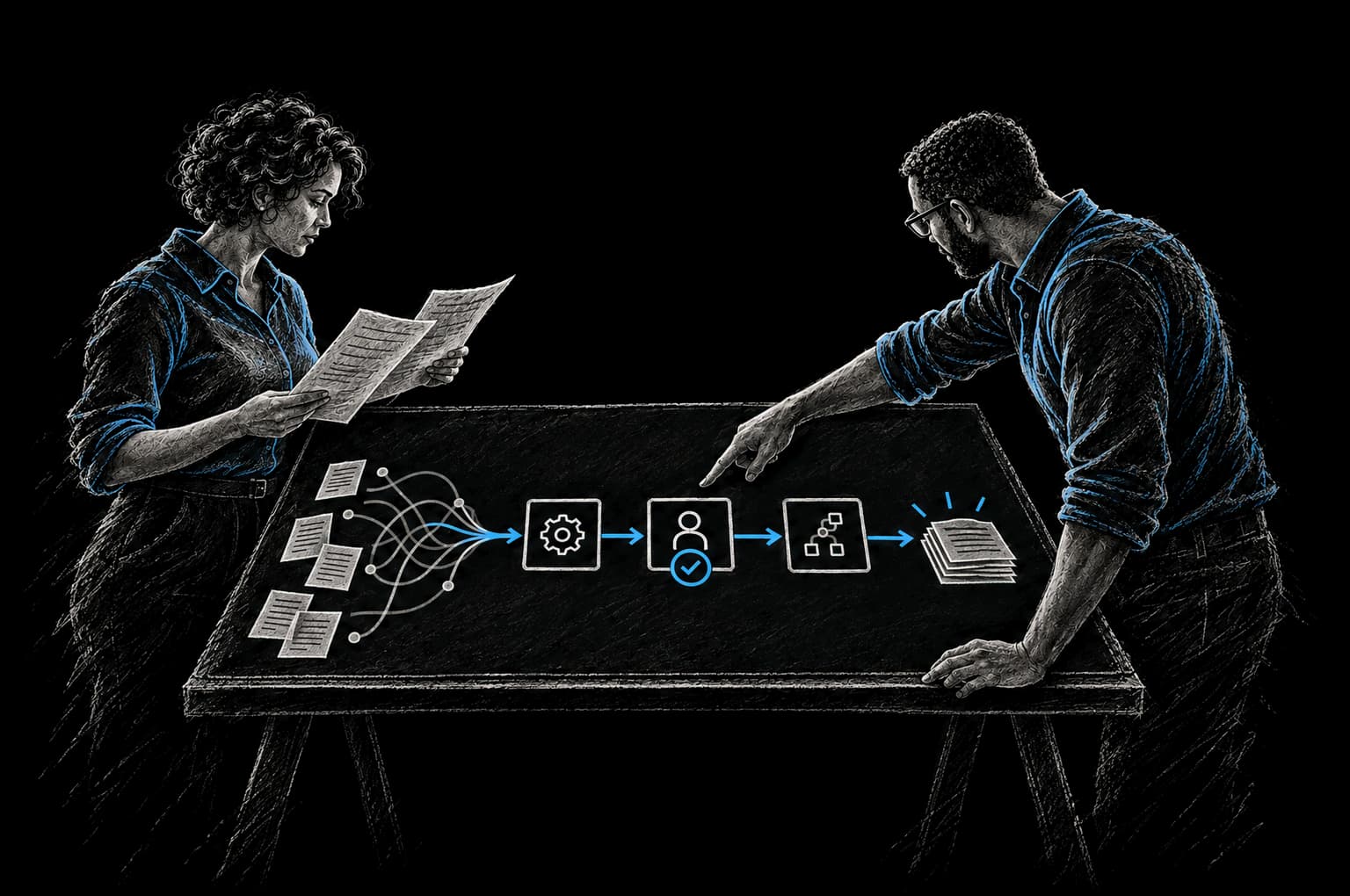
An AI Operating System consolidates operational data, automates workflows, and surfaces insight in real time. For PE-backed companies, that means:
Connected operational dashboards. Live data from ERP, financial systems, CRM, and inventory platforms all flow into a unified operational view. Portfolio company management and GP teams see real-time performance without waiting for manual reports. Anomalies (AR aging spikes, inventory variance, margin compression) surface automatically for investigation.
Post-acquisition system integration. Combine acquired company systems with existing portfolio infrastructure, using standard connectors where they exist and purpose-built ones where they don't. Standardize data definitions across companies so metrics mean the same thing everywhere. Consolidate workflows so teams aren't managing parallel processes.
Automated reporting and compliance workflows. Board decks, regulatory reports, and operational dashboards assemble automatically from live data. No more month-end scrambles. No more transcription errors. Reports reflect current state, not state from weeks ago.
Business operating systems replacing spreadsheets. Core operational workflows (inventory management, accounts receivable aging, supply chain visibility, customer health tracking) move from spreadsheets into connected systems. The system enforces consistency, prevents errors, and creates an audit trail.
AI-assisted exception management. Machine learning models flag operational anomalies that require attention: unusual inventory patterns, AR customers showing stress signals, margin compression by product line, or performance deviations from portfolio company benchmarks.
The result is a portfolio company that operates with professional infrastructure, generates clean data for due diligence, and exits with operational leverage intact.
Example Workflows: From Operations to Visibility
Real-Time Operational Dashboards
A portfolio company's management team and GP operating partners access a unified dashboard showing weekly revenue, profitability, cash conversion, and key operational metrics. The system pulls live data from ERP, accounting software, and CRM. Operating partners stop waiting for monthly board packs and start seeing performance in real time.
Post-Acquisition System Integration
After acquiring a complementary business, a portfolio company needs to combine operations without recreating systems from scratch. InTech builds connectors between legacy systems, standardizes data schemas, and migrates historical data. The combined entity moves onto unified infrastructure one workflow at a time, without waiting for a full rebuild.
Automated AR and Inventory Management
Instead of manually aging accounts receivable and reconciling inventory, the system manages it continuously. AI flags customers showing payment stress, identifies slow-moving inventory, and alerts management to action items. Manual month-end reconciliation shrinks dramatically.
Board Reporting Automation
Financial performance, operational KPIs, and strategic metrics assemble automatically into board decks each month. No more manual compilation, no more transcription errors, no more delays. The board sees current state, and management spends time analyzing results instead of compiling them.
Benchmark Reporting Across Portfolio
PE firms want to compare performance across portfolio companies. InTech builds standardized operational dashboards for each company that feed benchmarking reports at the GP level. Management teams can see how they compare, and GPs can spot improvement opportunities and best practices.
Implementation Approach: Speed and Impact
PE-backed companies operate under timelines and budget constraints. Building operational infrastructure can't take six months and require major budget approval.
Most engagements start with an assessment that picks the first workflow. An Express Pod puts one measurable improvement into production in weeks, with the timeline agreed in the Intent Contract before build starts.
In a portfolio company, that first improvement is often an operational dashboard connected to existing systems, a reporting automation, or a foundational data integration: proof of impact before a larger commitment.
The Build Pod is ongoing delivery capacity with a Product Delivery Lead, staffed to the shape of the work and managed against outcomes. Commercial terms are agreed per engagement. The Build Pod extends operational infrastructure: post-acquisition system integration, workflow automation, AI exception flagging, and ongoing optimization.
Configured for multiple workstreams, the same Build Pod handles enterprise-scale operational complexity: portfolio-wide benchmarking infrastructure, advanced AI workflows, and continuous operational improvement. Once a workflow is live, InTech Operate can run and improve it.
Frequently asked questions
How long does it take to build a portfolio company operating system?
It depends on complexity and scope. An Express Pod puts one measurable improvement into production in weeks, with the timeline agreed in the Intent Contract before build starts. Broader integrations and AI workflows are scoped the same way, one outcome at a time. We build the business case with you from your own baseline, so you can see the expected payback before you commit. The Intent Contract sets the baseline and the date we verify against.
Do you replace our existing ERP or CRM?
No. We build on top of your existing systems. We create connectors and integrations that unify data without requiring system replacement. That protects your existing investments and minimizes disruption.
Will these systems hold up in due diligence?
That is what we design for. We build clean, auditable infrastructure that prospective buyers can read as operational improvement, not technical debt. Data is consistent, workflows are documented, and systems are built for scalability.
What happens to the operating system after we exit?
The buyer inherits a portfolio company with professional operational infrastructure, reduced manual headcount, and clean data. That's an asset, not a liability. If the buyer prefers different systems, the data and workflows we've created are portable.
Do you require our team to learn new tools?
We build around your team's existing workflows. Many teams keep their existing tools and see automation and reporting improvements without new training. Where new tools make sense, we keep adoption friction low and provide training.
How much operational cost can we save?
Savings vary by company. We agree on the baseline and the target with you before work starts, and report the result against that baseline. Common measures are hours spent on manual reporting, reconciliation errors, and days to close the month.
From Friction to Proof
Bring us the part that’s getting in the way.
Tell our AI agent what you want to improve. We’ll help you find a useful first step.
Start with our AI agent. Find your next step.